
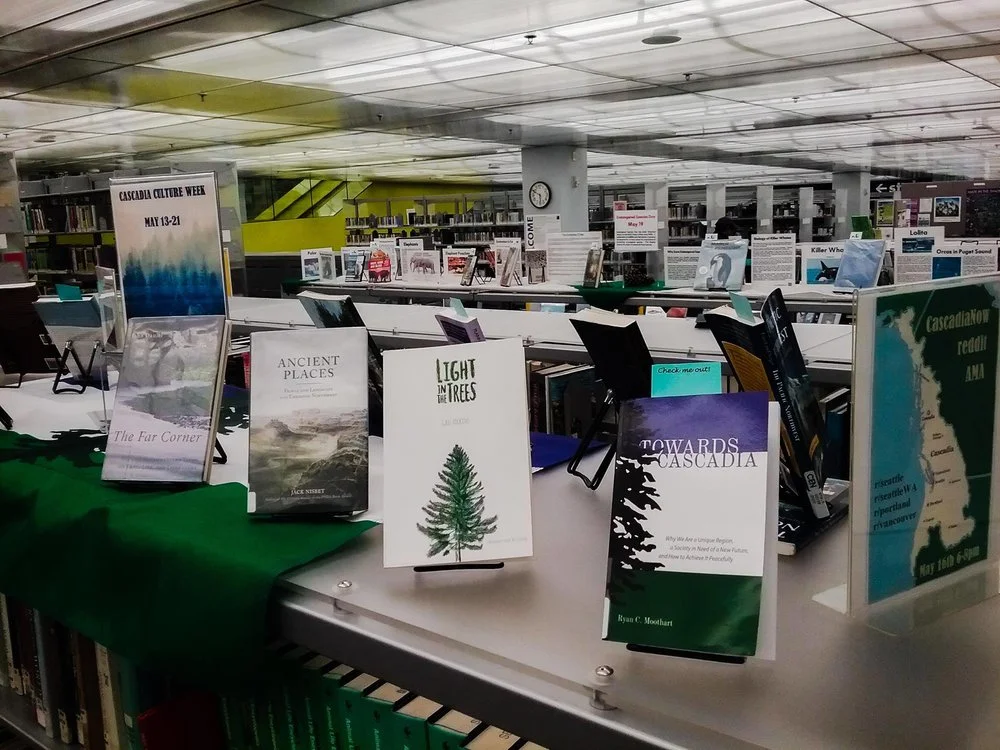
A Bioregional Reader
A suggested reading list on bioregionalism, its history, and its practice, with an emphasis on Cascadia and the wider network of bioregional thought. This is a living list. Entries range from the founding texts of the movement to recent scholarship, field guides, and the tools that help people come to know their own place.
Books
Foundational and general bioregionalism
- Andruss, Van, Christopher Plant, Judith Plant, and Eleanor Wright, eds. 1990. Home! A Bioregional Reader. New Society Publishers. The first broad anthology of bioregional writing, gathering the voices that defined the movement’s first generation.
- Berg, Peter, ed. 1978. Reinhabiting a Separate Country: A Bioregional Anthology of Northern California. Planet Drum. The founding anthology of reinhabitation, edited by the movement’s central organizer.
- Berg, Peter. 1995. Discovering Your Life-Place: A First Bioregional Workbook. Planet Drum Books. A hands-on workbook for coming to know the place where you live.
- Berry, Wendell. 1977. The Unsettling of America: Culture and Agriculture. Avon / Sierra Club Books. A landmark argument that culture and agriculture cannot be separated from the land that sustains them.
- Berry, Wendell. Another Turn of the Crank. Counterpoint.
- Cato, Molly Scott. 2013. The Bioregional Economy: Land, Liberty and the Pursuit of Happiness. Routledge.
- Carr, Mike. 2005. Bioregionalism and Civil Society. UBC Press.
- Evanoff, Richard. 2011. Bioregionalism and Global Ethics: A Transactional Approach to Achieving Ecological Sustainability, Social Justice, and Human Well-being. Routledge. Situates bioregionalism within a global ethic, arguing that living well in place and global responsibility reinforce one another.
- Glotfelty, Cheryll, and Eve Quesnel, eds. 2015. The Biosphere and the Bioregion: Essential Writings of Peter Berg. Routledge. The essential collection of Peter Berg’s writing across four decades of bioregional organizing.
- Jackson, Wes. 1994. Becoming Native to This Place. University Press of Kentucky.
- Kemmis, Daniel. 1990. Community and the Politics of Place. University of Oklahoma Press.
- Le Guin, Ursula K. 1985. Always Coming Home. Bantam. A visionary novel of a future people living in place in a transformed California, often read alongside the bioregional canon.
- Lippard, Lucy R. 1997. The Lure of the Local: Senses of Place in a Multicentered Society. The New Press.
- Lockyer, Joshua, and James R. Veteto, eds. 2013. Environmental Anthropology Engaging Ecotopia: Bioregionalism, Permaculture, and Ecovillages. Berghahn.
- Lynch, Tom, Cheryll Glotfelty, and Karla Armbruster, eds. 2012. The Bioregional Imagination: Literature, Ecology, and Place. University of Georgia Press.
- Mander, Jerry, and Edward Goldsmith, eds. 1996. The Case Against the Global Economy, and for a Turn Toward the Local. Sierra Club Books.
- McGinnis, Michael Vincent, ed. 1999. Bioregionalism. Routledge. A key scholarly volume that took stock of the movement and its ideas at the close of the century.
- Meyrowitz, Joshua. 1985. No Sense of Place: The Impact of Electronic Media on Social Behavior. Oxford University Press.
- Mills, Stephanie. 1995. In Service of the Wild: Restoring and Reinhabiting Damaged Land. Beacon Press. A meditation on ecological restoration as an act of reinhabitation.
- Naess, Arne. 1989. Ecology, Community and Lifestyle: Outline of an Ecosophy. Cambridge University Press.
- Sale, Kirkpatrick. 1985 (2000 reissue). Dwellers in the Land: The Bioregional Vision. Sierra Club Books / University of Georgia Press. The single most influential statement of the bioregional vision, and the movement’s standard reference text.
- Sale, Kirkpatrick. 1983. Mother of All: An Introduction to Bioregionalism. E.F. Schumacher Lectures.
- Sale, Kirkpatrick. 2017. Human Scale Revisited: A New Look at the Classic Case for a Decentralist Future. Chelsea Green Publishing. An updated restatement of the decentralist case by a foundational bioregional author.
- Snyder, Gary. 1974. Turtle Island. New Directions. The Pulitzer-winning collection that gave the movement its enduring call: find your place on the planet, dig in, and take responsibility from there.
- Snyder, Gary. 1990. The Practice of the Wild (including “Bioregional Perspectives” and “The Place, the Region, and the Commons”). North Point Press.
- Snyder, Gary. 1995. A Place in Space: Ethics, Aesthetics, and Watersheds. Counterpoint.
- Thayer, Robert L., Jr. 2003. LifePlace: Bioregional Thought and Practice. University of California Press.
Ecology, land, and watershed reference
- Bailey, Robert G. 1995. Descriptions of the Ecoregions of the United States. USDA Forest Service.
- Bailey, Robert G. 1996. Ecosystem Geography. Springer.
- Dasmann, Raymond. 1973. Biotic Provinces of the World. International Union for Conservation of Nature. An early biogeographic classification that helped give the bioregion its scientific footing; Dasmann later co-authored the founding reinhabitation essay with Peter Berg.
- Durning, Alan. 1996. This Place on Earth: Home and the Practice of Permanence. Sasquatch Books.
- Forman, Richard T. T. 1995. Land Mosaics: The Ecology of Landscapes and Regions. Cambridge University Press.
- Hawken, Paul. 1993. The Ecology of Commerce: A Declaration of Sustainability. HarperBusiness.
- Lipschutz, Ronnie D. 1996. Global Civil Society and Global Environmental Governance. SUNY Press.
- McHarg, Ian. 1969. Design with Nature. Doubleday / Natural History Press. The foundational text of ecological planning and map overlay analysis, a direct ancestor of bioregional mapping method.
- Natural Resources Law Center. 1996. The Watershed Source Book.
- Udvardy, Miklos D. F. 1975. A Classification of the Biogeographical Provinces of the World. IUCN Occasional Paper No. 18.
Regenerative practice and bioregional finance
- Brewer, Joe. 2021. The Design Pathway for Regenerating Earth. Earth Regenerators. The founding text of the Design School for Regenerating Earth and the Earth Regenerators network, arguing that regeneration proceeds through holistic landscapes, or bioregions, linked into a planetary network of learning.
- Power, Samantha, and Leon Seefeld. 2024. Bioregional Financing Facilities: Reimagining Finance to Regenerate Our Planet. The BioFi Project / Dark Matter Labs / Buckminster Fuller Institute. Presents the design, governance, and capitalization of Bioregional Financing Facilities, with templates for a bioregional trust, venture studio, investment company, and bank, plus twelve global case studies. An international bestseller.
- Wahl, Daniel Christian. 2016. Designing Regenerative Cultures. Triarchy Press. A widely cited synthesis of regenerative design across ecology, agriculture, and economy that frames bioregioning as the defining practice of regenerative cultures.
International bioregionalism
- Magnaghi, Alberto. 2000. Il progetto locale. Bollati Boringhieri. English: The Urban Village: A Charter for Democracy and Local Self-Sustainable Development, Zed Books, 2005. The foundational statement of the Italian territorialist school, which reworked bioregionalism as urban-bioregion planning.
- Magnaghi, Alberto. 2014. La biorégion urbaine: petit traité sur le territoire bien commun. Eterotopia France. The territorialist school’s core statement of the urban bioregion, and a main bridge between Italian and francophone bioregionalism.
- Magnaghi, Alberto, and Ottavio Marzocca, eds. 2023. Ecoterritorialismo. Firenze University Press. Open-access capstone of the Italian territorialist research program, published in the year of Magnaghi’s death.
- Fanfani, David, and Alberto Matarán Ruiz, eds. 2020. Bioregional Planning and Design, Volumes I and II. Springer. The main English-language bridge to the Italian and Spanish urban-bioregion current, including Magnaghi’s chapter on the territorialist approach to urban bioregions.
- Rollot, Mathias. 2018. Les Territoires du vivant: Un manifeste biorégionaliste. Éditions François Bourin (Wildproject reissue, 2023). Described as the first book-length bioregionalist manifesto in French, and a founding text of the francophone bioregional wave.
- Rollot, Mathias, and Marin Schaffner. 2021. Qu’est-ce qu’une biorégion? Éditions Wildproject (expanded edition, 2024). A widely cited introduction to the bioregion for French readers, with an entry devoted to Cascadia.
- Sale, Kirkpatrick. 2020. L’Art d’habiter la terre: la vision biorégionale. Éditions Wildproject. The French translation of Dwellers in the Land (1985), whose 2020 release anchored the francophone bioregional publishing wave, bringing the bioregional canon to French readers thirty-five years after original publication.
- Schaffner, Marin, Mathias Rollot, and François Guerroué, eds. 2021. Les Veines de la Terre: Une anthologie des bassins-versants. Éditions Wildproject. A French anthology of watershed thinking gathering Reclus, Geddes, Sale, Berg and Dasmann, Snyder, Shiva, and others.
- Sinaï, Agnès. 2023. Réhabiter le monde: Pour une politique des biorégions. Éditions du Seuil. Argues for a politics of bioregions as a survival response to the Anthropocene, extending the American bioregional tradition into French policy debate.
- Sinaï, Agnès, Yves Cochet, and Benoît Thévard. 2020. Le Grand Paris après l’effondrement: Pistes pour une Île-de-France biorégionale. Éditions Wildproject / Institut Momentum. One of the most cited applications of bioregional thinking to a major metropolis.
- Poli, Daniela. 2019. Le comunità progettuali della bioregione urbana. Quodlibet. An applied study of the urban bioregion through a bioregional agricultural park near Florence.
- Morán Alonso, Nerea, José Luis Fernández Casadevante, Fernando Prats, and Agustín Hernández Aja. 2023. Biorregiones: De la globalización imposible a las redes territoriales ecosostenibles. Icaria Editorial. The flagship title of the recent Spanish biorregionalismo debate, presenting the bioregion as the minimum unit for planning ecosocial transitions.
- Gugenberger, Eduard, and Roman Schweidlenka. 1995. Bioregionalismus: Bewegung für das 21. Jahrhundert. Packpapier Verlag. The earliest German-language monograph on bioregionalism.
- Desai, Pooran, and Sue Riddlestone. 2004. Baioriijonarizumu no chosen (The Challenge of Bioregionalism, Japanese translation of Bioregional Solutions: For Living on One Planet). Gunjosha. One of the few Japanese-language books carrying bioregionalism in its title.
Bioregional mapping and community atlases
- Aberley, Doug, ed. 1993. Boundaries of Home: Mapping for Local Empowerment. New Society Publishers. The standard handbook of bioregional and community mapping, still the movement’s central reference for putting maps in the hands of the people who live in a place.
- Aberley, Doug, ed. 1994. Futures by Design: The Practice of Ecological Planning. New Society Publishers.
- Harrington, Sheila. 1995. Giving the Land a Voice: Mapping Our Home Places. Salt Spring Island Community Services. A foundational Cascadia community-mapping project, gathering local knowledge of home places across the Salish Sea islands.
- Harrington, Sheila, and Judi Stevenson, eds. 2005. Islands in the Salish Sea: A Community Atlas. TouchWood Editions. A landmark artistic community atlas of the Salish Sea islands.
- Lydon, Maeve. 2018. Mapping Our Common Ground. Common Ground Publishing.
Articles and Essays on Bioregionalism
- Aberley, Doug. 1999. “Interpreting Bioregionalism: A Story from Many Voices.” In Michael Vincent McGinnis, ed., Bioregionalism, 13-42. Routledge. A movement-insider history of bioregionalism told through its many contributing voices.
- Alexander, Don. 1996. “Bioregionalism: The Need for a Firmer Theoretical Foundation.” The Trumpeter.
- Berg, Peter, and Raymond Dasmann. 1977. “Reinhabiting California.” The Ecologist 7, no. 10: 399-401. The essay that named reinhabitation and defined a bioregion as both a geographical terrain and a terrain of consciousness. The origin point of bioregional thought.
- Booth, Kelvin J. 2012. “Environmental Pragmatism and Bioregionalism.” Contemporary Pragmatism 9, no. 1.
- Dubiau, Antoine. 2023. “Writing the Intellectual History of Bioregionalism.” Metropolitics, December 22, 2023. One of the few English-language essays introducing the European bioregion wave to North American readers, tracing the movement from Berg and Dasmann through Magnaghi to the French reception.
- Evanoff, Richard. 2017. “Bioregionalism: A Brief Introduction and Overview.” The Aoyama Journal of International Politics, Economics and Communication, no. 99.
- Fike, Michelle Summer, and Sarah Kerr. 1995. “Making the Links: Why Bioregionalism Needs Ecofeminism.” Alternatives 21, no. 2: 22-27.
- Hubbard, Ella. 2023. “Where Are You At? Re-engaging Bioregional Ideas and What They Offer Geography.” Geography Compass 17, no. 10. Argues that bioregionalism is less a homogeneous movement than a discursive forum, identifying ontological, critical, and processual tendencies in bioregional thought.
- Lynch, Tom. 2016. “Always Becoming Bioregional: An Identity for the Anthropocene.” Caliban: French Journal of English Studies, no. 55: 103-112.
- McGinnis, Michael Vincent. 2000. “The Bioregional Quest for Community.” Landscape Journal 19, no. 1/2.
- Plant, Judith. 1990. “Revaluing Home: Feminism and Bioregionalism.” In Andruss et al., Home! A Bioregional Reader, 21-23. New Society Publishers.
- Sale, Kirkpatrick. 1983. “Mother of All.” E.F. Schumacher Lecture.
- Taylor, Bron. 2000. “Bioregionalism: An Ethics of Loyalty to Place.” Landscape Journal 19, no. 1/2.
- Taylor, Bron. 2005. “Bioregionalism and the North American Bioregional Congress.” Encyclopedia of Religion and Nature.
- Thackara, John. 2019. “Bioregioning: Pathways to Urban-Rural Reconnection.” She Ji: The Journal of Design, Economics, and Innovation 5, no. 1. An early academic anchor for the bioregioning-as-verb literature, proposing care for the bioregion as value-creating activity.
- Thomashow, Mitchell. 1999. “Toward a Cosmopolitan Bioregionalism.” In McGinnis, Bioregionalism, 121-132. Routledge.
- Van Newkirk, Allen. 1975. “Bioregions: Towards Bioregional Strategy for Human Cultures.” Environmental Conservation 2, no. 2. An early use of the bioregion concept as a strategy for human cultures.
- Waldenberger, Johanna, and Federico Savini. 2025. “Bioregionalism and Degrowth: Addressing the Urban-Other Divide.” Planning Theory and Practice 26, no. 3: 402-419. Proposes a bioregional spatial-planning approach for degrowth built on five dimensions, addressing the urban-rural divide without localist bias.
- Wearne, Samuel, Ella Hubbard, Krisztina Jonas, and Maria Wilke. 2023. “A Learning Journey into Contemporary Bioregionalism.” People and Nature 5, no. 6: 2124-2140. A landmark survey of the current bioregional revival, mapping how contemporary bioregionalism is understood and practiced across several countries.
Reports and Frameworks
- Aberley, Douglas, and Michael George. 1998. An Introduction to Bioregional Mapping. Tsleil-Waututh Nation Treaty Office. A working guide to bioregional mapping developed in partnership with the Tsleil-Waututh Nation.
- Amazon Sacred Headwaters Initiative. 2021. Bioregional Plan 2030: Ecological Transitions for the Amazon Sacred Headwaters of Ecuador and Peru. A large-scale bioregional plan advanced by an Indigenous-led initiative, and a reference model for bioregional planning at scale.
- One Earth. 2023. Bioregions 2023: The One Earth Bioregions Framework. A global biogeographical framework delineating 185 bioregions within a nested hierarchy of subrealms and realms, explorable through an interactive navigator and used for conservation policy and public advocacy.
- Sightline Institute (Northwest Environment Watch). 2004-2009. Cascadia Scorecard: Seven Key Trends Shaping the Northwest. An annual progress report tracking health, economy, population, energy, sprawl, forests, and pollution across the Cascadia region.
- University of Washington Climate Impacts Group. 2022. Blueprint for a Resilient Cascadia. Identifies priority climate-adaptation actions coordinated across the political boundaries of the Cascadia region.
Cascadia and the Bioregion
The naming and mapping of Cascadia
- McKee, Bates. 1972. Cascadia: The Geologic Evolution of the Pacific Northwest. McGraw-Hill. The first use of “Cascadia” as a name for the region, in a geology textbook, later taken up and redefined as a bioregion.
- McCloskey, David. Cascadia Institute. The bioregional cartographer who defined Cascadia as a bioregion in 1981, “a land of falling waters,” and drew the first Cascadia map without political lines in 1988. See the Cascadia Institute essays “On Bioregional Boundaries” and “The Ish Map Story” (2014).
Cascadia natural and cultural history
- Koberstein, Paul, and Jessica Applegate. 2023. Canopy of Titans: The Life and Times of the Great North American Temperate Rainforest. OR Books. Documents the coastal temperate rainforest from Northern California to Alaska, the ecological backbone of the Cascadia bioregion, the industry practices destroying it, and the Indigenous communities who have lived in it for millennia. By the editors of Cascadia Times.
- Mathews, Daniel. 2021. Cascadia Revealed: A Guide to the Plants, Animals, and Geology of the Pacific Northwest Mountains. Timber Press. A natural history guide to more than 950 species across the Coast and Cascade ranges, the Olympics, and southwestern BC mountains, framing the mountain Northwest explicitly as Cascadia.
- Thompson, Jerry. 2011. Cascadia’s Fault: The Coming Earthquake and Tsunami That Could Devastate North America. Counterpoint Press. A foundational popular account of how scientists uncovered the Cascadia Subduction Zone and its magnitude-9 earthquake cycle, with a foreword by Simon Winchester.
Cascadia poetry and literature
- Bradfield, Elizabeth, CMarie Fuhrman, and Derek Sheffield, eds. 2023. Cascadia Field Guide: Art, Ecology, Poetry. Mountaineers Books. A hybrid field guide profiling 128 organisms across 13 living communities, pairing natural history with poems and illustrations from more than 100 writers and 14 artists. Winner of the Pacific Northwest Book Award.
- Collis, Stephen. 2016. Once in Blockadia. Talonbooks. A poetry collection built partly from the 2014 Burnaby Mountain resistance to the Trans Mountain pipeline, engaging the commons and Anthropocene resistance from within Cascadia’s thin green line.
- Nelson, Paul E. 2020. A Time Before Slaughter: Featuring Pig War and Other Songs of Cascadia. Apprentice House Press. A serial poem of Cascadian history in verse, treating the 1859 Pig War, Salish art and origin stories, and Seattle regional history within an explicitly bioregional frame.
- Nelson, Paul E., George Stanley, Barry McKinnon, and Nadine Maestas, eds. 2015. Make It True: Poetry from Cascadia. Leaf Press. The first bioregional poetry anthology of Cascadia, collecting 89 poets from across the bioregion.
- Nelson, Paul E., Jason Tetsuzen Wirth, and Adelia MacWilliam, eds. 2023-2024. Cascadian Zen: Bioregional Writings on Cascadia Here and Now (Volumes I and II). Watershed Press. A two-volume anthology exploring Zen practice and bioregional consciousness in Cascadia, with contributors including Gary Snyder, Jane Hirshfield, Rena Priest, and Robert Bringhurst; described as possibly the first poetry collection drawn from a single bioregion.
- Priest, Rena, ed. 2023. I Sing the Salmon Home: Poems from Washington State. Empty Bowl Press. An anthology of 167 salmon poems from more than 150 Washington poets, edited by a Washington State Poet Laureate and Lummi Nation member.
- Sund, Robert. 1983. Ish River. North Point Press. Poems of the “Ish River country,” the Salish estuary rivers whose names end in -ish, an early literary naming of the Cascadia watershed.
Cascadia society, economy, and cross-border region
- Beylier, Pierre-Alexandre. 2023. Constructing a Cross-Border Region in the Pacific Northwest: The Residents of Cascadia at the Canada/US Border. Routledge. A monograph testing whether Cascadia functions as a lived cross-border region, drawing on data from border-area residents.
- Callenbach, Ernest. 1975. Ecotopia. Banyan Tree Books. The influential novel in which Washington, Oregon, and Northern California secede to build an ecological society, a touchstone for the Cascadia imagination.
- Shobe, Hunter, and Geoff Gibson. 2017. “Cascadia Rising: Soccer, Region, and Identity.” Soccer and Society 18, no. 7. Examines how Timbers, Sounders, and Whitecaps supporters mobilize the bioregional narrative of Cascadia, including the Cascadia Cup and Cascadian iconography.
- Todd, Douglas, ed. 2008. Cascadia: The Elusive Utopia. Ronsdale Press. A study of religion, spirituality, and secularity in the Pacific Northwest, and the predecessor to its scholarly successor below.
- Bramadat, Paul, Patricia O’Connell Killen, and Sarah Wilkins-Laflamme, eds. 2022. Religion at the Edge: Nature, Spirituality, and Secularity in the Pacific Northwest. UBC Press. A university-press study of religion, irreligion, and reverential naturalism in the Cascadia bioregion, and a scholarly successor to Todd’s Cascadia: The Elusive Utopia.
- Wolf, Edward C., and Seth Zuckerman, eds. 1999 (2nd ed. 2003). Salmon Nation: People, Fish, and Our Common Home. Ecotrust. Defines Salmon Nation as the bioregion of Pacific salmon watersheds, with essays by Elizabeth Woody, Jim Lichatowich, Richard Manning, and Freeman House.
Watershed and reinhabitation classics
- House, Freeman. 1999. Totem Salmon: Life Lessons from Another Species. Beacon Press. A bioregional classic by a former salmon fisherman turned watershed restorationist, part natural history and part manifesto on community-based restoration and a bioregional ethic. Winner of a Bay Area Book Reviewers Association award.
- House, Freeman. 2023. A Watershed Runs Through You: Essays by Freeman House. Empty Bowl Press. A posthumous collection of House’s essays and talks on salmon restoration, community, and reinhabitation in the Mattole watershed.
The case for Cascadia and secession scholarship
- Griffiths, Ryan D. 2025. The Disunited States: Threats of Secession in Red and Blue America and Why They Won’t Work. Oxford University Press. A political scientist’s examination of American secession threats through interviews with advocates, analyzing polarization, legality, and small-state arguments, and concluding that secession is not a viable answer.
- Savitt, Elias V. 2025. Cascadian Independence: A Rising Movement for an Independent Northwest Amid Growing Regionalism in the United States and Canada. Arcadia University ScholarWorks. An undergraduate history capstone examining the prospect of Oregon, Washington, and British Columbia forming an autonomous or independent Cascadia, included as a marker of continuing academic attention to the movement.
Bioregional Programs and Resources in the Pacific Northwest
- Cascadia Illahee: Passport to the Bioregion. Department of Bioregion, 2019. A 56-page full-color bioregional passport covering nine regions of Cascadia with ecoregion information and Indigenous language place names; the first print run of 1,000 copies sold out.
- Cascadia SPOKE (A Bioregional Journal). Cascadia Department of Bioregion, 2022- . A volunteer-run bioregional community newspaper, printed on recycled newsprint in Seattle and mailed free four times a year, inspired by Planet Drum’s Raise the Stakes and decades of bioregional maps and newsletters.
- Curriculum for the Bioregion. Jean MacGregor, The Evergreen State College. A faculty and program network integrating place-based and sustainability learning across Northwest campuses.
- Bioregional Planning and Community Design. University of Idaho, Jaap Vos.
- Planet Drum Foundation. San Francisco, 1973- . The organization founded by Peter Berg and Judy Goldhaft that launched bioregional thought; its long-running journal Raise the Stakes and its bioregional “bundles” seeded the movement’s first network.
- Éditions Wildproject. Marseille, 2008- . The independent French publisher that since 2019 has been the main French-language channel for bioregionalism, issuing the Sale translation, Qu’est-ce qu’une biorégion?, and Les Veines de la Terre.
Interactive Tools: Mapping Your Watershed
- Berg, Peter. 1995. Discovering Your Life-Place: A First Bioregional Workbook. Planet Drum Books.
- Bailey, R. G. 1994. Ecoregions of the United States (map). USDA Forest Service.
- Salish Sea Atlas. Aquila Flower, Western Washington University, 2020. An open-access digital atlas of the Salish Sea bioregion combining interactive maps, interpretive text, and downloadable harmonized geospatial datasets across the transboundary marine waters and watersheds of Washington and British Columbia.
- Cascadia Bioregion Atlas. Western Washington University, 2021. A collaboratively written living atlas of the Cascadia bioregion built by GIS Certificate candidates under Dr. Aquila Flower, with five chapters covering physical and biological landscapes, hydrography, demography, transportation and energy, and land use.
- Learning from Cascadia (Ecotopia Today). Brian Holmes, 2018. An interactive online multimedia atlas of the Cascadia bioregion mapping Indigenous languages, dams, salmon, fossil-fuel infrastructure, and the Hanford site, framed around biocultural governance and ecological restoration.
- QGIS. A free, open-source geographic information system, the standard desktop tool for community and bioregional mapping. qgis.org
- Green Map System. A global network for community sustainability mapping, and a common entry point for local place-based mapping projects. greenmap.org
- Native Land Digital (NativeLands). An interactive map of Indigenous territories, languages, and treaties, widely used to ground bioregional maps in Indigenous geographies. native-land.ca
Film and Media
- Occupied Cascadia. 2012. A documentary film on bioregionalism, resistance, and reinhabitation in Cascadia.
- Maps with Teeth. Regenerate Cascadia. A short film on bioregional mapping as an act of power and stewardship, available on the Regenerate Cascadia YouTube channel.
- Artistic Community Mapping with 19 Islands. A video on artistic, community-led mapping practice in the Salish Sea islands.