
The Bioregion
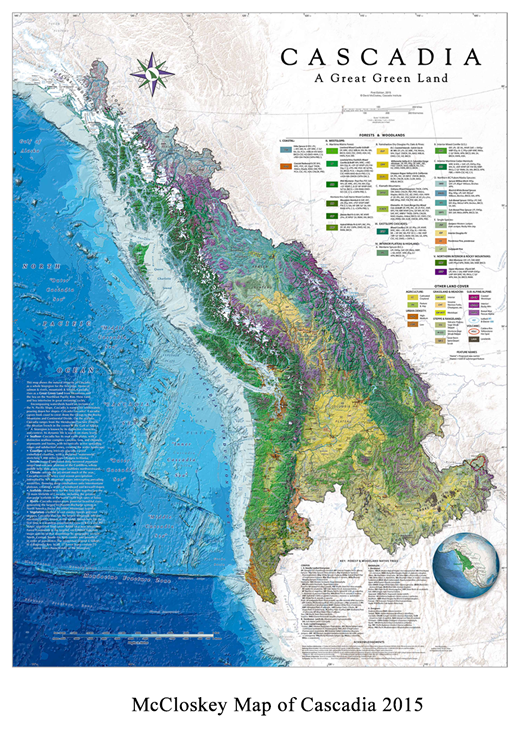
The Cascadia Bioregion encompasses all or portions of Washington, Oregon, Idaho, California, Nevada, Wyoming, Montana, Alaska, British Columbia, and Alberta. “Bioregion” is short for bio-cultural region: a geographically based area defined by physical traits such as land and soil composition, watershed, climate, flora, and fauna, together with the cultural traits of the people who live within it and act upon it. Cascadia includes the entire watershed of the Columbia River, reaching inland as far as the Continental Divide, along with the Cascade Range from Northern California well into Canada. The delineation of a bioregion follows watersheds and ecoregions, grounded in the belief that political boundaries should match ecological and cultural boundaries, and that culture stems from place.
Size, Population, and Economy
As of 2017, measured by the combination of the states and provinces making up the bioregion (not including California), Cascadia would be home to slightly more than 16 million people (16,029,520) and would have an economy generating more than $1.112437 trillion in goods and services annually, or $1.613147 trillion if including Northern California. At the larger figure, Cascadia would rank as the world’s 9th largest economy, roughly equivalent to Canada or Italy. By land area, Cascadia would be the 20th largest country in the world at 534,572 sq mi (1,384,588 km2), placing it just behind Mongolia. Its population would be similar in size to that of Ecuador, Guatemala, or Scandinavia.
With a GDP of $356 billion, Cascadia’s largest city, Seattle, has an economy slightly smaller than Thailand’s but larger than Colombia’s or Venezuela’s. The region also has one of the fastest growing clean energy sectors in the world. It is energy sufficient, generates almost all of its energy from renewable resources, and already exports electricity to surrounding states and provinces.
The most dominant sectors of Cascadia’s economy are agriculture, science and technology, trade, media, and tourism. Much of the economic activity concentrates in the coastal cities, while inland areas focus largely on agriculture. The strongest economic corridor is the Cascadia megaregion, stretching from Vancouver through Seattle to Portland and Eugene. Some of the largest and most well known companies based in the region include Amazon.com, Starbucks, Costco, Boeing, Microsoft, REI, Nordstrom, T-Mobile, Lions Gate, Nike, Adidas, Columbia, and many others.
Alongside this creative economy sits a distinctive balance of learning and livability. Cascadia is home to the second largest tech hub in the world, one of the highest standards of living, and advanced medical and educational institutions.
Geography and Ecology
Stretching along more than 2,500 miles of Pacific coastline, Cascadia extends as long and as far as the salmon swim: from the glacial cold of Alaska’s Copper River watershed to Cape Mendocino in the south and the Yellowstone Caldera in the east. Cascadia contains the largest tracts of untouched old growth temperate rainforest in the world, including 7 of the top 10 carbon absorbing forests on Earth and the world’s tallest trees, along with thousands of volcanoes, hot springs, rivers, lakes, inlets, islands, and ocean waters. It shelters some of the last diminishing, though still impressive, wild habitats of salmon, wolves, bear, whale, and orca. In all, more than 350 bird and mammal species, 48 reptiles, hundreds of fungi and lichens, and thousands of invertebrates and soil organisms call Cascadia home.
Trade and Resources
As a coastal region, Cascadia is a major gateway for trade to and from North America and carries a rich maritime tradition. Together, Cascadia operates the largest civilian ferry fleet in the world and holds nine of eleven deep water ports and dry-dock facilities on the West Coast of the United States and Canada. It is often described as the “Thin Green Line” between ecologically destructive resource extraction in the North American interior and heavily fossil fuel dependent economies across the Pacific, and as a “Gateway to Asia” for the global supply of consumer goods and services.
While Cascadia generates a large percentage of its own energy from renewable resources, the area remains heavily dependent on resource extraction, providing large percentages of North American timber, minerals, and mined resources for construction materials. The region also holds a wide degree of technical expertise in developing, designing, and producing state of the art civilian and military aircraft and aviation technology. With Poulsbo, Bangor, and the Trident nuclear submarine base only 20 miles west of Seattle, Cascadia currently holds the largest stockpile of active nuclear warheads in the world: more than a quarter (1300) of the roughly 4000 active warheads held by all countries combined.
Agriculture and Wine
With its diversity of ecosystems, from the Pacific Ocean to the Rocky Mountains, the region is one of the most ecologically rich farming areas in the United States [1]. Roughly 30% of the land area within Cascadia is dedicated to farmland and ranching, and more than 300 different crops grow well here, including 99% of the hops used in North America. West of the Cascade Range, deep soils and a mild maritime climate produce a vast array of fruits and vegetables. East of the Cascades, rolling arid hills grow much of the nation’s wheat, potatoes, apples, and pears.
The climate is also well suited to a newly emerging wine industry. Cascadia is the largest producer of premium wine in North America, with 1600+ wineries, bottles sold in all 50 states and exported worldwide, and an annual economic impact of more than 8.96 billion U.S. dollars. Washington State, the region’s largest wine producer, alone includes 350 grape growers and 50,000 acres of vineyards, approximately the size of Napa Valley [2].
A Culture That Bridges Borders
The Cascadia bioregion was long united by Indigenous cultures, and briefly as the Oregon Country and Oregon Territory, before being split and divided by colonial powers. It still retains a distinct regional culture that bridges those boundaries. Some describe this culture as rugged, independent, and self-sufficient; others call it a “progressive libertarianism” that values the right of people to do as they please so long as it does not negatively affect others, supports social systems that improve collective well-being such as education and healthcare, and maintains a data-based approach to fiscal accountability and responsibility. Reflecting this, the region was among the first places in North America to legalize gay marriage and marijuana.
The Cascadia Subduction Zone
In a physical sense, the borders of Cascadia describe the journey water makes as it flows from the edge of the continental crust, uplifted by the Cascadia Subduction Zone, also known as the Cascadia fault. There, the Juan de Fuca plate slips beneath the North American plate in a convergent plate boundary that stretches from northern Vancouver Island in Canada to Northern California.
This fault is responsible for the deep thrust earthquakes known as Cascadia megaquakes and for the active volcanism of the Cascade mountains that has shaped the region for tens of thousands of years. The last Cascadia megaquake occurred on January 26, 1700, with an estimated moment magnitude of 8.7 to 9.2. It ruptured from mid-Vancouver Island south along the Pacific Northwest coast as far as Northern California, stretching more than 1,000 kilometers (620 miles) with an average slip of 20 meters (66 ft), and produced a massive tsunami felt as far away as Japan. Cascadia megaquakes occur every 300 to 500 years. Much of Cascadian planning and cooperation centers on increasing the resilience of communities in the face of earthquakes above a 9.0 magnitude that could impact the largest population centers in the region, such as Vancouver, Victoria, Seattle, and Portland, along with the tsunamis and volcanic eruptions that could follow. Notable past eruptions include Mount Mazama (Crater Lake) about 7,500 years ago, the Mount Meager massif (Bridge River Vent) about 2,350 years ago, and Mount St. Helens in 1980.
Cascadia Quick Facts
- Capital: undecided (candidates often named include Olympia, Portland, Salem, Seattle, and Spokane)
- Largest city: Seattle
- Some of the top languages used: English, Spanish, Chinese, Vietnamese, Russian, Tagalog, Korean, German, Japanese, Hindi, French, Arabic, Khmer, and Punjabi
- Demonym: Cascadian
- Total area: 1,384,588 km2 (534,572 sq mi)
- Population: 16,029,520
- GDP (2017): USD $1.112437 trillion, as measured by British Columbia, Washington, Oregon, Alaska, and Idaho combined, or $1.613147 trillion if including Northern California
The 2017 statistics are compiled from US and Canadian census records by combining information from the states of Washington, Oregon, Idaho, and Alaska and the province of British Columbia. If the entire Cascadian bioregion were taken into account, GDP and population would be much higher. Many values use exchange rates, which may vary.
Top 10 Largest Cities by Population
The most populous cities in the Cascadia Bioregion according to 2016 data, not including greater metropolitan areas, are as follows.
- Seattle, Washington: 684,451
- Vancouver, British Columbia: 631,490
- Portland, Oregon: 602,568
- Spokane, Washington: 213,272
- Tacoma, Washington: 211,277
- Boise, Idaho: 205,671
- Vancouver, Washington: 174,826
- Eugene, Oregon: 158,131
- Salem, Oregon: 157,967
- Bellevue, Washington: 141,400
Learn More
Read the story of the Cascadia Movement, or explore maps and mapping resources for the bioregion. Are we missing something, or do you have an updated figure? Let us know.