
In Popular Culture
A simplified glossary of the Cascadia Movement. Being Cascadian is more than using the name or happening to fall within the borders of the Cascadia bioregion. Rather, it connects traditions of our bioregion that have evolved over thousands of years to our practices today, and is a regional identity rooted in a love of place that we all choose to become. Below is a list created by the Department of Bioregion of events, popular culture, organizations, and terms that define important elements within the Cascadia movement and how bioregionalism has evolved in the Pacific West region of North America.
A
- Adidas Cascadia Commercial: Adidas featured Cascadia and the Portland Timbers Army prominently in a commercial (“Revolutions are born from simple ideas…”).
- Agalloch: Portland band formed in 1995 whose blend of black metal, neofolk, and post-rock is credited with helping popularize the Cascadian black metal scene; live shows are staged with wood, incense, and Pacific Northwest imagery. The band disbanded in 2016, reformed in 2023, and played Portland reunion shows in 2025 including Revolution Hall on August 16, 2025. Reunion coverage ran in New Noise Magazine and Spectrum Culture.
- Alda: Tacoma, Washington band formed in the late 2000s whose atmospheric black metal is consistently framed as Cascadian, mixing black metal with American folk and prog influences and lyrics rooted in the Cascade landscape. After a six-year gap the band released its fourth album, A Distant Fire, in October 2021 on Eisenwald, composed in Eatonville, Washington between 2017 and 2019.
- An Introduction to Cascadia Psych: Bandcamp Daily scene report by Katie Kurtz, November 8, 2021, defining a Cascadia psych sound rooted in the bioregion, explicitly framing Cascadia from the Copper River to Cape Mendocino and noting the independence movement and Cascadia flags. It highlights Plankton Wat, Rose City Band, Midday Veil, Shabazz Palaces, and others.
- Autonomy Cascadia: journal of Bioregional Decolonization for the Northeast Pacific Rim.
B
- Bioregional Activation Tour (Regenerate Cascadia): A month-long tour in October 2023 that traveled to fourteen communities across Oregon, Washington, and British Columbia asking how to regenerate the Cascadia bioregion. More than a thousand people participated, including Indigenous knowledge keepers, regenerative leaders, and elders. It was co-facilitated with Joe Brewer and Penny Heiple of the Design School for Regenerating Earth and launched the Regenerate Cascadia program.
- Bioregional Confluencing 2025: A decentralized global gathering held September 9 to 10, 2025 under the banner Ambling Toward Planetary Bioregional Congressing, combining autonomous local confluences in bioregions worldwide with an online global conference. Organizers built on work by And Now What, the Equinox Collective, the Design School for Regenerating Earth, and r3.0, and the Cascadia Department of Bioregion promoted participation in Cascadia.
- Black Jack Bioregional: infoshop and bookstore in Bend, Oregon founded 2014 by Cathasaigh Ó Corcráin; hosted Cascadian events such as Real Food Cascadia.
- Brothers Cascadia Brewing: Portland-area brewery displaying a Cascadia flag, run by Abram Goldman-Armstrong. In May 2023 the Vancouver, Washington brewery announced a second location, Brothers Cascadia Evergreen Pub, at 108 W Evergreen Boulevard in downtown Vancouver, a space that previously housed Salmon Creek Brewery and Old Ivy Brewery. The original Hazel Dell taproom continues to operate, and both locations remain open as of 2026.
C
- Camp Cascadia: The 2013 Mt. Tabor reservoir protest in Portland was covered by Portland Mercury, Willamette Week, Portland Tribune, KGW, and 750KXL. The Camp Cascadia name was revived in 2019 as a camping program of the Cascadia Department of Bioregion at the North River Reserve, a 93-acre property at Cosmopolis, Washington in the Willapa Hills, opening an inaugural camping season in August 2019 with native plant walks, invasive species work parties, and communal fire circles. This 2019 program is distinct from the 2013 Mt. Tabor protest of the same name.
- Cascadia 55th: independent scouting association in Oregon, “Traditional Scouting for Everyone.”
- Cascadia 9.0 (video game series): Free earthquake-preparedness video game series (Cascadia 9.0, 9.1, 9.2) launched October 2022 by a Lewis & Clark College research team led by geoscientist Liz Safran with computer scientist Peter Drake. Players navigate a Portland devastated by a magnitude 9 Cascadia quake, learning survival skills such as water purification and sanitation. Profiled by Seattle Met in February 2024 (“Can a Video Game Prepare Us for the Big One?”) and covered by the Seattle Times and Portland Monthly.
- Cascadia (2018 short film): Fantasy short film in which a young girl must cross a remote West Coast island alone to get help for her family, facing her fears in an ancient old-growth forest. Listed on IMDb as a 2018 short.
- Cascadia (audio drama podcast): Scripted science-fiction podcast from 911 Podcasts (2021 to 2025), set ten years after a cataclysmic Cascadia Subduction Zone earthquake and tsunami devastates the Pacific Northwest, following a submarine crew exploring the newly exposed ocean floor. Directed by Antonio Cordero; a second season set 25 years later followed.
- Cascadia (board game): Tile-laying board game by designer Randy Flynn (Flatout Games / AEG, 2021) built around the habitats and wildlife of the Pacific Northwest, with players assembling ecosystems and wildlife corridors. Won the 2022 Spiel des Jahres, the board game world’s highest honor, bringing the Cascadia name to an international audience.
- Cascadia (glass installation by Cable Griffith, SEA Airport): Permanent public artwork of 22 hand-painted glass panels by Seattle artist Cable Griffith, created 2019 to 2020 and debuted with Seattle-Tacoma International Airport’s modernized N Concourse in May 2021. The work wraps the satellite train station entrance with patterned abstractions of Cascadia’s mountains, forests, and waterfalls.
- Cascadia (melodysheep single): Instrumental single released October 7, 2020 by melodysheep, the project of Washington-based filmmaker and composer John D. Boswell, known for the Symphony of Science and Timelapse of the Future videos. The track is named for his home region.
- Cascadia (novel, H.W. “Buzz” Bernard): Disaster thriller by former Air Force weather officer and Weather Channel meteorologist H.W. Buzz Bernard, published July 2016, depicting a Cascadia Subduction Zone megaquake and tsunami striking the Pacific Northwest coast over an Independence Day weekend.
- CASCADIA (Nathie Katzoff glass exhibition): Exhibition of large-scale cast and fused glass works by Seattle artist Nathie Katzoff at the NK Gallery in Seattle, unveiled May 2022. Pieces up to seven feet carried abstractions of the mountains and oceans of the Pacific Northwest under the Cascadia title.
- Cascadia Art Exhibit at the Reach Gallery (Abbotsford, BC): January to March 2013.
- Cascadia Art Museum: Museum in Edmonds, Washington, open since 2015 and devoted to recovering the overlooked visual art history of the Northwest through original exhibitions and scholarly publications. It marked its tenth anniversary with the exhibition “A Decade of Rediscovery” (August to November 2025) and a free community Cascadia Day celebration on September 13, 2025.
- Cascadia Arts Collective (Seattle Cascadia Arts Collective): A 501(c)(3) program of the Cascadia Department of Bioregion empowering artists within the Salish Sea and Cascadia bioregion, active in Seattle since the mid 2010s. The collective built nine giant parade puppets, co-chaired art for the Seattle Womxn’s March and Science March, ran banner-making at the Fremont Solstice Parade, hosted Guerrilla Art School nights, and received a 2016 Fremont Arts Council McKay Grant.
- Cascadia Association Football Federation (CAFF): Governing body for the Cascadia representative soccer team, a CONIFA member representing Oregon, Washington, and British Columbia as a distinct bioregion. Cascadia finished 6th at the 2018 CONIFA World Football Cup in London (losing a quarter-final to eventual champions Karpatalya) and, after friendlies against Chagos Islands, Darfur United, and Kernow, saw its 2020 World Football Cup qualification voided by COVID-19. In August 2022 CAFF announced a partnership with the Department of Bioregion for a 2023 return, including the CONIFA North America Football Cup in Oaxaca, Mexico (September 2023); Cascadia remains ranked 10th in CONIFA world rankings.
- Cascadia Beyond: regional transportation conference hosted by Seattle Mayor Ed Murray, 2015.
- Cascadia BioFi Conference: Inaugural bioregional finance conference held May 16 to 18, 2025 at the historic Georgetown Steam Plant in Seattle’s Duwamish River Valley, convened by Regenerate Cascadia and partners. More than 200 people working across finance, circular economy, land regeneration, Indigenous rematriation, community art, technology, and participatory governance gathered to design bioregional funding ecosystems, including an introduction to Regenerate Cascadia’s Bioregional Financing Facility. The conference incorporated a Cascadia Day BBQ, elders panel, and poetry reading on May 17.
- Cascadia Bioregion Atlas (WWU collaborative student atlas): Collaboratively written living atlas of the Cascadia bioregion created in winter 2021 by GIS Certificate candidates in Western Washington University’s Environmental Studies Department under Dr. Aquila Flower. Five chapters cover physical and biological landscapes, hydrography and oceanography, human demography, transportation and energy, and land use, ownership, and Indigenous peoples, with maps and open spatial datasets built to overcome the single-jurisdiction limits of most transboundary geodata.
- Cascadia Bioregional Congresses: biennial gatherings, late 1980s to early 1990s; first July 1986 at Evergreen State College, Olympia (100+ delegates).
- Cascadia Bioregional Party: Secessionist bioregional political party seeking greater independence and autonomy for the Cascadia bioregion, covering Idaho, Oregon, Washington, and British Columbia. Formed in late 2020 out of post-2016 organizing including a Cascadia Election Response network, and registered with the IRS on May 18, 2021, symbolically Cascadia Day.
- Cascadia Bioregional Summit (2024): The first-ever Cascadia bioregional summit, a hybrid gathering held over roughly ten days throughout Salmon Nation in fall 2024. The opening gathering in September 2024 featured Skagit Elder Jay Bowen, with a keynote by Joe Brewer on November 4 and a Cascadia UnConference on November 10 and 11. It marked the formal launch of the Regenerate Cascadia program.
- Cascadia Bioregionalism Yahoo Group: primary movement communication channel, early 2000s to 2006-07.
- Cascadia Black Metal: Genre blend of nature and metal originating around Olympia, WA. The scene continued producing major releases from 2018 to 2026. Wolves in the Throne Room released Primordial Arcana (2021) and the Crypt of Ancestral Knowledge EP (2023); Fauna signed to Lupus Lounge/Prophecy Productions in 2019 and released Ochre & Ash in September 2025; Tacoma’s Alda released A Distant Fire (2021); and Portland’s Agalloch, credited with popularizing the sound, reformed in 2023 and played Portland reunion shows in 2025. The scene also sustains solstice festivals at Red Hawk Avalon in Pe Ell, Washington (Thirst for Light, then Litha Cascadia, now Cascadian Midsummer) and the Cascadian Yule gathering in Olympia.
- Cascadia Branch: student group founded 2012 at Portland Community College; produced the Cascadia Welcome and Resource Guide.
- Cascadia Bus: bus owned and operated by CascadiaNow! founder Brandon Letsinger; shuttle at Cascadia NW festival; longest trip to Standing Rock.
- Cascadia Buzzword of the Month: BC Business Magazine, 2013.
- Cascadia Campout: Intentional three-day gathering of camping, music, art, education, and connection in Veneta, Oregon, created by Ashley Bonn with a stated purpose of honoring the land and deepening connection. A Kickstarter campaign completed in April 2023 raised $10,633 from 72 backers to launch the event.
- Cascadia Center for Regional Development: Discovery Institute program founded in 1993 as the Cascadia Project, directed by Bruce Agnew, promoting high-speed passenger rail, I-5 freight mobility, seamless border crossings, and binational tourism from Vancouver BC to Eugene. It received a ten-year $9.35 million Gates Foundation grant in 2003 and remains active on corridor transportation policy, including autonomous, connected, electric, and shared (ACES) vehicle initiatives.
- Cascadia Center for Sustainable Design and Construction (Bullitt Center): opened Earth Day 2013, Capitol Hill, Seattle; the greenest office building in the world. The Bullitt Foundation, builder of the Bullitt Center, announced in June 2019 it would sunset its grantmaking, awarding final grants and spending down its endowment by April 2024 after granting more than $200 million since 1992 under Earth Day organizer Denis Hayes. The Bullitt Center continues as a gift to the Pacific Northwest environmental community, leasing below-market office space to regional environmental groups in perpetuity; the annual Bullitt Prize passed to Washington Conservation Action.
- Cascadia Composers: Portland-based composers organization founded in 2008 by David Bernstein and Greg Steinke, now the largest local chapter of the National Association of Composers USA with over 70 member composers. It presents multiple concerts a year of new music by Pacific Northwest composers and runs the In Good Hands series pairing composers with young musicians.
- Cascadia Commons: Portland organization by Colin Ferguson promoting re-occupation of the commons.
- Cascadia Con: eighth NASFiC, SeaTac WA, September 1 to 5, 2005; released Northwest Passages: A Cascadian Odyssey (ed. Cris DiMarco).
- Cascadia Conference (USA Ultimate college ultimate): USA Ultimate’s Division I college ultimate frisbee conference named Cascadia spans Washington, Oregon, Alaska, and British Columbia, one of the few cross-border conferences in US college sport. In the 2026 season it fielded five nationally ranked teams: Washington, UBC, Western Washington, Oregon, and Victoria.
- Cascadia Confluence: intersectional conference at Portland State University, March 6, 2014.
- Cascadia Conservation District: Chelan County conservation district.
- Cascadia Convergence: annual CascadiaNow! gathering, began as Cascadia Rainingman. The gathering held its 2019 edition July 5 to 7 at the North River Reserve in Brooklyn, Washington. No later editions have been documented, and the event appears to have gone dormant after the COVID-19 pandemic; the CascadiaNow! page still describes it as an annual volunteer-run weekend of art, music, presentations, and workshops.
- Cascadia Convoy to Standing Rock: CascadiaNow! plus Backbone Campaign convoy; 45 people, roughly 80 tarpees, winter supplies.
- Cascadia Cooperative Conference: First biannual conference celebrating the cooperative economic model in the Cascadia bioregion, hosted by the Northwest Cooperative Development Center on August 25 and 26, 2025 at the Parkview Event Space in Seattle. Programming explicitly framed the region as the Cascadia bioregion, spanning British Columbia, Idaho, Oregon, and Washington, and tied to the UN International Year of Cooperatives.
- Cascadia Crossing: finalist name for the Tri-Met bridge, 2014 (lost to Tilikum Crossing).
- Cascadia Cup: Supporters’ trophy created 2004 by Timbers, Sounders, and Whitecaps supporters. The competition continued through 2026. Seattle won 2019 and 2021, Portland won 2022 and 2024, Vancouver won 2023 and 2025; the 2020 edition was not awarded after the Cascadia Cup Council ruled pandemic matches played without supporters would not count. In 2024 all three clubs tied on 8 points and Portland claimed its sixth title on a goals-scored tiebreaker; Vancouver’s 2025 win was a record eighth title. The supporter-owned, supporters’-council-trademarked competition entered its 22nd year in 2026.
- Cascadia Culture Week: weekend before to weekend after Cascadia Day (May 18) every year. See also Cascadia Day.
- Cascadia Daily News: Independent daily news outlet launched in Bellingham, Washington in January 2022, founded by David Syre with veteran Seattle Times journalist Ron Judd as founding executive editor. Named for the region and a recurring source of coverage on Cascadia cross-border and movement stories.
- Cascadia Dark Ale: IPA style using bioregional hops, officially recognized 2010. The style faded to relative obscurity in the 2020s, with most national coverage using the rival black IPA name, but saw documented revivals: Firestone Walker returned Wookey Jack in 2021 (selling out within days) and Stone Brewing canned Sublimely Self-Righteous again in early 2022. Pacific Northwest breweries including pFriem Family Brewers and Hopworks continue to brew and label versions under the Cascadian Dark Ale name.
- Cascadia Day: May 18 each year, anniversary of the Mt. St. Helens eruption; chosen by David McCloskey. Cascadia Day and Cascadia Culture Week continued as annual observances through 2026, promoted with yearly celebration guides from the Department of Bioregion and Cascadia Underground. In 2025 the day was marked by a Cascadia Day BBQ, elders panel, and poetry reading on May 17 at the Cascadia BioFi Conference at Seattle’s Georgetown Steam Plant, and a May 18 community celebration at Alberta Park in Portland organized by Cascadia Stack.
- Cascadia Democratic Action: Grassroots organization co-founded by journalist-organizer Andrew Engelson and Drew Alcosar pursuing a nonviolent path toward Cascadian autonomy and independence, aiming for fall 2028 ballot initiatives in Washington and Oregon asking voters whether their state should leave the United States. Profiled by the New York Times in June 2026 and Eugene Weekly in May 2026.
- Cascadia Department of Bioregion: 501(c)(3) nonprofit and social movement organization launched November 5, 2018 by Brandon Letsinger with Trevor Owen, Jay Conrad, and other organizers after Letsinger stepped down from CascadiaNow! in November 2017. Styled as a satirical bioregional counterpart to a state department, it promotes bioregionalism and Cascadian identity through embassies (including the Seattle Embassy), a Cascadia Diplomatic Corps training program, annual Cascadia Day and Cascadia Culture Week observances, the Cascadia Passport, and the Cascadia Spoke newspaper. It hosts cascadiabioregion.org, the public hub for the Cascadia movement, and later provided the administrative backbone for Regenerate Cascadia. (See also CascadiaNow! for the organizational lineage.)
- Cascadia Digital: Official digital adaptation of the board game Cascadia, developed and published by Dire Wolf Digital. It entered Steam Early Access in November 2024 and fully released on Steam, iOS, and Android on February 19, 2025, with online crossplay, 15 solo scenarios, challenges, and daily trek modes set in the Pacific Northwest.
- Cascadia Dirt Cup: regional mountain bike race series. The series remains active as a six-round tour of Pacific Northwest trail systems produced by Race Cascadia, an event organization producing PNW enduro races since 2012. The 2025 series visited Dry Hill, North Slope, Cold Creek, Galbraith Mountain, Darrington, and Raging River, and a 2026 series is scheduled including North Slope, Raging River, Yacolt Burn, Galbraith Mountain, Tiger Mountain, and Post Canyon.
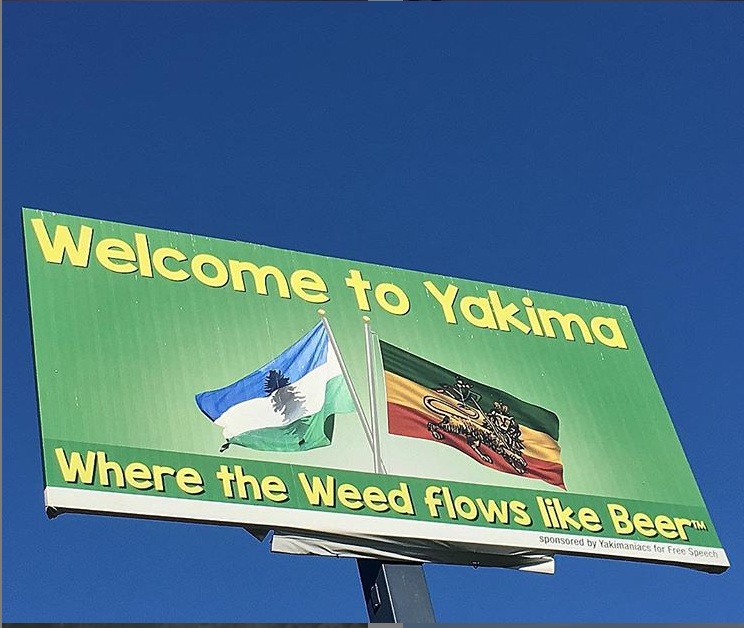
- Cascadia Doug Flag: Designed by Alexander Baretich 1994; green, white, and blue with a Douglas fir. Since 2018 the flag gained its highest-profile commercial adoption when Seattle Sounders FC placed it on the back neckline of the club’s 2020-2021 home jersey with Baretich’s permission. The design, created in the 1994-1995 academic year, passed its 30th anniversary in 2024-2025. Baretich continues to steward the flag and sells handcrafted flags through the Cascadian Flag Cooperative.
- Cascadia Earth First Rendezvous: regional action camp, June 2012.
- Cascadia Field Guide: Art, Ecology, Poetry: Hybrid field guide to the Cascadia bioregion edited by Elizabeth Bradfield, CMarie Fuhrman, and Derek Sheffield, published by Mountaineers Books on March 1, 2023. It profiles 128 organisms organized into 13 living communities such as Salish Sea and Pine Forest rather than Western taxonomy, pairing natural history with poems and illustrations from more than 100 writers and 14 artists. Won the Pacific Northwest Book Award and an Independent Publisher Book Award silver medal.
- Cascadia Food Initiative: started 2013 in Portland by World Food Travel Association.
- Cascadia Foodshed Financing Project: Collaboration of Pacific Northwest foundations and impact investors, active 2014 to 2019, that used market-based strategies to grow the regional food economy of the Cascadia foodshed. Partners included the Whatcom Community Foundation, Seattle Foundation, and Greater Tacoma Community Foundation.
- Cascadia Forest Defenders: Direct action forest defense group based in Eugene, Oregon, emerging from the mid-1990s Warner Creek and Cascadia Free State blockades. Active campaigns since 2018 include tree-sits against the Goose, Thurston Hills, Flat Country, and Breitenbush timber sales.
- Cascadia Free State: 1995-96 Earth First! blockade protecting Warner Creek; led to Cascadia Wild, Earth First! Cascadia, and Cascadia Forest Defenders.
- Cascadia Freedom Caravan: Rick Fellows, Bruce Wilkinson, and others, nine-day trip to the Mexican border.
- Cascadia Freedom Parties: Bend, Oregon organizing events.
- Cascadia Grains Conference: Annual conference founded 2013, held at South Puget Sound Community College in Olympia and organized with Washington State University, framed as revitalizing a grain economy in the Cascadia region across Washington, Oregon, and British Columbia. It gathered farmers, millers, maltsters, bakers, brewers, and distillers, drawing over 400 attendees in 2019. Verified editions run through January 2020; continuation past a planned January 2021 edition is unverified.
- Cascadia Grandslam: annual slam poetry competition hosted by Rain City Slam.
- Cascadia Grill: Olympia, WA restaurant displaying the flag.
- Cascadia High-Speed Rail (program): Formal name of the ultra-high-speed ground transportation program pursued jointly by WSDOT, the Oregon Department of Transportation, British Columbia, and Metro, targeting sub-one-hour trips at up to 220 mph between Vancouver BC, Seattle, and Portland. The arc runs from the 2017-18 feasibility study through the 2019 business case, the 2020 Framework for the Future, 2023 entry into the FRA Corridor Identification and Development program, and a $49.7 million federal grant in December 2024 funding a service development plan targeted for 2028. Public engagement on route and service options began in 2026.
- Cascadia High-Speed Rail Coalition (Fast Forward Cascadia): Campaign coalition backing Cascadia high-speed rail under the slogan “Let’s get on Board to a Better Future,” active by 2025 at highspeedrailcascadia.com. Members span business (Amazon, Microsoft, Intel, Costco, REI, Expedia Group), labor unions (IBEW, LiUNA, IUOE), local governments including King, Snohomish, and Pierce counties, and transportation and environmental groups such as Climate Solutions, Futurewise, and Seattle Subway.
- Cascadia Homebrew & Brewery: taproom and brewery, Olympia WA.
- Cascadia Illahee Passport (Cascadia Passport): The Department of Bioregion’s bioregional passport program. It shipped its first print run in April 2019, 1,000 copies printed locally by Girlie Press in Seattle’s Central District. The 56-page full-color passport covers nine regions of the Cascadia bioregion with ecoregion information and Indigenous language place names. The first run sold out; passports were sold for $20 or included with Department of Bioregion membership.
- Cascadia Illuminati: esoteric community organization, Seattle.
- Cascadia Innovation Corridor: Envisioned 2016 by Christy Clark and Jay Inslee; expanded to Oregon 2017. Since 2018 the initiative has formalized under Challenge Seattle with former Washington Governor Christine Gregoire chairing its steering committee, backed by Microsoft. It has held annual cross-border conferences (Vancouver 2018, Seattle 2019, virtual forums 2020, Vancouver 2021, Blaine 2022, Portland 2024 on housing, Seattle 2025 on AI and its tenth anniversary), funded the Washington-Oregon-BC high-speed rail studies, and released the Cascadia Vision 2050 (2020) and Moving to Climate Action (2022) reports. The November 2021 conference produced a Washington-Oregon-British Columbia memorandum of understanding on ultra-high-speed rail. In September 2025 the Cascadia Department of Bioregion published a response urging the corridor to embed bioregional, place-based values, arguing innovation must serve life, not just markets.
- Cascadia Institute: David McCloskey’s project; detailed Cascadia map featured by ESRI 2015.
- Cascadia International Rally Championship: grassroots rally competition.
- CASCADIA International Women’s Film Festival: Annual Bellingham, Washington festival founded in 2017, one of the only US festivals dedicated to films directed by women and the only one of its kind in the Pacific Northwest, presenting more than 250 women directors to date. The 2025 edition ran April 24 to 27 with 27 films from 10 countries, and the 10th anniversary festival is scheduled for April 30 to May 4, 2026 with an online edition May 7 to 17.
- Cascadia International Wine Competition: Annual judging of Pacific Northwest wines staged by Great Northwest Wine of Richland and Kennewick, Washington, billed as the largest competition of wines from Washington, Oregon, Idaho, British Columbia, and Montana. It has run since 2013 and carried the Cascadia name since 2016, with the 14th annual judging scheduled for May 5 to 7, 2026.
- Cascadia Journal: Online opinion publication founded by Andrew Engelson covering Cascadian politics, independence, and bioregional issues, including a running “Cascadia today” news digest and essays such as “Cascadia and soft secession” (September 2025).
- Cascadia Junior: Standalone children’s version (ages 6+) of the board game Cascadia, published by Flatout Games and AEG in spring 2025 with art by Beth Sobel. Players draft habitat tiles to build corridors and match wildlife of the Cascadian wilderness (bears, hawks, elk, salmon, foxes), earning sighting tokens for a personal panorama board.
- Cascadia: Alpine Lakes: Standalone follow-up to the board game Cascadia by Randy Flynn and Flatout Games, funded on Kickstarter October 14 to December 6, 2025 with retail release expected in 2026. It adds elevation as a mechanic, with stacked double-hex tiles and five new alpine species (cougar, eagle, marmot, mountain goat, pika) across three alpine habitats of the Cascadia region.
- Cascadia: Landmarks: First expansion for the board game Cascadia, co-published by Flatout Games and AEG. It adds natural landmark pieces with dynamic endgame scoring, additional wildlife scoring cards and habitat tiles, and components for 5 to 6 players. Crowdfunded on Kickstarter and released to retail in fall 2023.
- Cascadia: Life and Breath of the World: 2013 anthology (Univ. of Hawaii; Frank Stewart and Trevor Carolan, eds.) with Bringhurst, Brody, Carr, Davis, Chief Dan George, Kingston, Lopez, Maracle, Snyder, Wagamese, Zwicky, and others.
- Cascadia: Rolling Rivers and Cascadia: Rolling Hills: Two standalone flip-and-roll-and-write spinoffs of the board game Cascadia by Randy Flynn, with art by Beth Sobel, published by Flatout Games and AEG. Players roll dice to collect wildlife and complete habitat cards across riverine and prairie environments of the Cascadia region; the two sets combine for 1 to 8 players across 8 maps. Crowdfunded in early 2024 and released in fall 2024.
- Cascadia: The Hidden Fire: PBS-aired documentary from Global Net Productions (2004) on the earthquake hazards of the Cascadia Subduction Zone, combining two decades of research, Native American oral history, and survivor accounts to promote preparedness across the Pacific Northwest.
- Cascadia Magazine: Founded by Seattle journalist Andrew Engelson with a first online issue in January 2018, it published journalism, essays, fiction, poetry, and photography from across the Cascadia bioregion. The project did not survive the pandemic and ceased publication around 2020. Engelson launched a successor, Cascadia Journal, in 2025.
- Cascadia Map (McCloskey): Cover of the 2015 ESRI book. David McCloskey’s Cascadia Institute released a second edition (marketed as “Cascadia Map 2”) of the 2015 bioregional map, sold in paper and laminated formats through Feathered Star Productions, the McCloskey family imprint. The revision doubles terrain and seafloor resolution, renders the Cascadia Subduction Zone in 3-D relief, and expands icefield and glacier coverage; a companion Ish River – Salish Sea map was also issued. The Department of Bioregion announced restocked copies in November 2023. Metsker Maps’ “Cascadia Bioregion Wall and Reference Map” is the same Cascadia Institute map.
- Cascadia Masters Rugby Union: Masters (over-38) rugby union spanning clubs in British Columbia and Washington, founded in 1995 as the Pacific Northwest Over 40 Rugby Union, Canada’s first old boys union, and renamed the Cascadia Masters Rugby Union in 2022 in reference to its clubs being located in the Cascadia region. It welcomed co-ed rosters in 2015 and runs fall and spring test schedules.
- Cascadia Matters: Bend-based group; produced Occupied Cascadia.
- Cascadia Mayors Council: founded 1996 by Philip Owen and Paul Schell.
- Cascadia Medal (Rock’n’Roll Run): 2014 limited edition medal for completing PDX, SEA, and VAN races.
- Cascadia Megaquake: last event January 26, 1700, M8.7-9.2; recurrence 300-500 years.
- Cascadia Megaregion: America 2050 designation, Vancouver to Portland; 17% of land, 80%+ of population. The megaregion connecting Vancouver BC, Seattle, and Portland is now home to more than 9 million people, up roughly 1.7 million since 2005. Boston Consulting Group analysis for the Cascadia Innovation Corridor projects growth to about 12 million residents by 2050 and warns of Los Angeles-level congestion by 2035 without intervention, proposing new hub cities linked by high-speed transit.
- Cascadia Monthly: quarterly newsletter, Seattle 2011-12 (Adam Munson, Michael Hodges, Brandon Letsinger).
- Cascadia Mosaic Collective: Collective of mosaic artists across Oregon and Washington united by regional affiliation under the Cascadia name. The group has mounted three exhibitions at six galleries and art centers and held group residencies at Centrum in Port Townsend, Washington in January 2022 and January 2023.
- Cascadia National Party: founded by John Phillips September 9, 2001.
- Cascadia NW Festival (Cascadia Northwest Arts and Music Festival): Annual, Granite Falls, since 2015. After a two-year COVID hiatus, the festival returned in 2022 and moved to venues including the Lookout Arts Quarry near Bellingham (2023) and later the Darrington Bluegrass Music Park beneath Whitehorse Mountain. Its tenth annual edition ran June 20 to 22, 2025, the year it transitioned to nonprofit status under the Department of Bioregion. On February 25, 2026 organizers announced the Darrington venue board had declined to renew the June contract, suspending the 2026 edition while the festival seeks a new venue, with social channels signaling a 2027 return.
- CascadiaNow!: 501(c)(3) founded 2005 by Brandon Letsinger; transitioned 2014 to fiscal sponsorship and social movement organization. Letsinger stepped down in November 2017, and CascadiaNow!’s Cascadia movement programming was carried into the new Cascadia Department of Bioregion, launched November 5, 2018. CascadiaNow! itself continued as a Seattle-based 501(c)(3) focused on fiscal sponsorship of grassroots community projects, a program branded CascadiaStrong, and by 2024 housed roughly 20 fiscally sponsored projects, making it one of the larger fiscal sponsorship organizations in Washington State.
- CascadiaNow! Podcast (Seattle): Movement-run podcast of the Seattle CascadiaNow! chapter, announced January 8, 2018 via Cascadia Underground. Planned coverage included Indigenous language and culture, in-city and off-grid living, resistance across the bioregion, Cascadian business, and a future Cascadia. No episodes are locatable on major platforms as of 2026; the run appears to have been short-lived.
- CascadiaNow! Radio Program: talk radio with host Zane Levine, House of Sound.
- CascadiaNow! Visions of Cascadia: 2009 NCECA arts exhibition, Seattle, curated by Aaron Murray.
- CascadiaNow! Micronations Exhibit: May to September 2014, CAAC Seville, Spain (“Lo que ha de venir ya ha llegado”).
- Cascadian Beer Podcast: Podcast telling the stories behind craft beer in the Pacific Northwest, running since around 2016 with more than 90 episodes, focused on breweries across British Columbia and the wider region and self-identified as Cascadian.
- Cascadian Caravan to the Peace Arch: 2012 event (Portland June 29, Seattle June 30, Peace Arch July 1).
- Cascadian Explorations of Cartography: exhibit, White Stag building, Portland, November 2012.
- Cascadian Flag Cooperative: A cooperative run by Doug flag designer Alexander Baretich that sells handcrafted Cascadian flags, patches, shirts, and other bioregion-themed merchandise. The site frames the flag as representing love of the bioregion rather than nationalist pride.
- Cascadian Flag Making Cooperative (Indiegogo): Portland, Oregon cooperative that ran an Indiegogo campaign in mid-2015 to purchase equipment and materials for producing locally made Doug flags, with flag designer Alexander Baretich as a founding member. Its stated goals were local production, fidelity to the flag’s bioregional symbolism, quality assurance from the designer, and income for members. Covered by Cascadia Underground and Village Portland in 2015.
- Cascadian Midsummer: Annual volunteer-run summer solstice festival at Red Hawk Avalon in Pe Ell, Washington, organized by the Cascadian Animism collective and continuing the Thirst for Light and Litha Cascadia lineage under its current name since about 2023. The weekend spans black metal, dark folk, and experimental music with workshops, ritual, and no cell reception; the 2026 edition is scheduled for June 19 to 22.
- Cascadian Olympians: biennial list via the Cascadia Subreddit.
- Cascadian Prophets (podcast): Interview podcast of the Cascadia Poetics LAB hosted by Paul E. Nelson, featuring Cascadian poets, culture workers, and Indigenous leaders on poetry and deepening connection to place. It draws on the LAB’s decades-long radio interview archive; guests and archival subjects include Robert Bringhurst, Daphne Marlatt, and Colleen J. McElroy.
- Cascadian Tifo: Cascadia Cup choreographed displays; largest June 24, 2012 (280’x80′, 20,000+ sq ft, largest in MLS history).
- Cascadian Yule: Annual winter solstice gathering based in the Olympia, Washington area, established by elders of the Cascadian black metal scene roughly two decades ago and originally organized in support of imprisoned earth-defense activists. Editions span folk, black metal, soundscape, dance, mythtelling, and theater around a solstice feast; documented editions run from 2013 through a twentieth edition at Littlerock Posse Hall.
- Cascadia, Oregon: town founded 1892; first written use of “Cascadia.”
- Cascadia Partner Forum: Transboundary network of natural resource practitioners in Washington and British Columbia, formed in summer 2012, working to build the adaptive capacity of the Cascadia landscape and its species under climate change. It convenes the Blueprint for a Resilient Cascadia adaptation strategy and co-developed the TerrAdapt: Cascadia platform.
- Cascadia Party of British Columbia: Registered provincial political party formed in 2016 advocating sovereignty for the Cascadia bioregion; it nominated two candidates in the 2017 British Columbia general election, neither elected. Former candidate Cory Pahl was quoted in 2026 Canadian Press coverage of the movement. The party ran no candidates in the 2024 BC general election and was deregistered by Elections BC on November 12, 2024.
- Cascadia Playbook: State of Oregon emergency management succession manual. Oregon’s Office of Emergency Management released Version 3.0 in late 2018, a roughly 100-page reorganization of the state’s earthquake and tsunami response plan, restructuring each play around specific time frames (first hour, first six hours, first 12 hours and beyond) for the two weeks after a Cascadia Subduction Zone rupture. Covered by KOIN and KGW in December 2018 and by a US News commentary in January 2019.
- Cascadia Poetics LAB (SPLAB): Literary arts nonprofit founded by Paul E. Nelson on December 14, 1993 in Auburn, WA as SPLAB (Seattle Poetics LAB), renamed Cascadia Poetics LAB effective September 1, 2021 to reflect its bioregional mission. It has produced over 600 hours of interview programming, the Cascadia Poetry Festival since 2012, Watershed Press, and the Cascadian Prophets podcast. Nelson first encountered bioregionalism in a 1994 interview with Peter Berg of Planet Drum Foundation.
- Cascadia Poetry Festival: Recurring bioregional poetry festival founded by Paul E. Nelson; the first edition was held March 2012 at SPLAB in Seattle’s Columbia City with headliner Sam Hamill. Editions include Seattle 2014, Nanaimo BC 2015, Tacoma 2017, a Becoming Cascadian retreat in 2018, Anacortes 2019, Seattle 2023 (CPF7, which launched Cascadian Zen Vol. I), Hugo House Seattle 2024 (CPF8), and Rainier Beach venues in October 2025 (CPF9). The festival produced the anthologies Make It True, Make It True meets Medusario, and Samthology.
- Cascadia Prepared: Oregon-based nonprofit founded in January 2017 dedicated to preparing communities for the Cascadia Subduction Zone earthquake and tsunami and subsequent recovery, recruiting members from Northern California through Oregon and Washington to British Columbia. It partners with the Cascadia Region Earthquake Workgroup, the Red Cross, and others.
- Cascadia Premier League: Adult amateur soccer league covering Washington and Oregon with a promotion and relegation system, built on the Western Washington Premier League (debuted 2018) and operating under the Cascadia name by 2022. The 2022 season fielded 18 men’s teams and launched a 7-team women’s division.
- Cascadia Rail (advocacy organization): Volunteer advocacy organization founded in 2018 with members across Washington, Oregon, and British Columbia supporting high-speed rail connecting the Cascadia region. It publishes route proposals and mobilizes public comment on the state-led studies, with chapters spanning Vancouver, Bellingham, Seattle, Tacoma, Spokane, and Portland.
- Cascadia Rail Summit: Summit hosted at Microsoft headquarters in Redmond, November 6 to 8, 2019, convening officials, business leaders, and rail experts from Washington, Oregon, and British Columbia to build momentum for Vancouver-Seattle-Portland high-speed rail following the July 2019 business case. Speakers included Christine Gregoire and Microsoft government affairs staff.
- Cascadia Research Vessel: finalist name for NOAA King County research vessel, 2016.
- Cascadia Resiliency and Networking Gathering: G.O.S.S.I.P., September 9 to 15, 2013, Umpqua Forest.
- Cascadia Resist: June 9, 2017 Paramount Theatre benefit (Death Cab for Cutie, The Decemberists, Sera Cahoone) for the ACLU and Planned Parenthood.
- Cascadia Review: online poetry review and journal.
- Cascadia Rising: 2016 joint 9.0 CSZ earthquake/tsunami exercise; 20,000+ participants. FEMA and Washington, Oregon, and Idaho ran Cascadia Rising 2022 (CR22) June 13 to 17, 2022, the second national-level exercise simulating a magnitude 9.0 Cascadia Subduction Zone earthquake and tsunami. Built on lessons from the 2016 exercise, more than 600 participants from tribal nations, state and federal agencies, private sector, and nonprofits took part in a largely virtual, discussion-based format focused on critical transportation and mass care.
- Cascadia Rising Review: Online and print literary magazine dedicated to the art and literature of the Pacific Northwest, founded 2017 with an inaugural issue on February 14, 2018, publishing fiction, nonfiction, poetry, comics, and plays as a paean to the region, with a companion podcast of author readings. Now defunct.
- Cascadia Rivalry (NWSL Cascadia Derby): The Portland Thorns versus Seattle Reign fixture, dating to the NWSL’s founding season in 2013, is widely branded the Cascadia Rivalry or Cascadia Derby and considered the league’s oldest rivalry. The 43rd meeting on August 10, 2025 drew 21,811 to Providence Park, the largest NWSL crowd of that season, and the 44th on March 20, 2026 drew a record home-opener crowd. Both clubs also fielded reserve sides in the WPSL in 2024, extending the Cascadia branding to a second league.
- Cascadia Sasquatch: 14-foot parade Sasquatch created 2014 for the Fremont Solstice Parade.
- Cascadia Scorecard (report series): Annual progress report for the Northwest published by Northwest Environment Watch, renamed Sightline Institute in 2006. The first edition, Cascadia Scorecard 2004: Seven Key Trends Shaping the Northwest, tracked health, economy, population, energy, sprawl, forests, and pollution across the Cascadia region; editions continued through 2009. (Complements the Sightline Institute entry.)
- Cascadia Seaweed: Kelp cultivation company founded in 2019 in Sidney, British Columbia, growing native seaweed on marine farms owned in partnership with coastal First Nations and processing it into regenerative agricultural biostimulants and livestock feed. A certified B Corp; the Tsawout First Nation became shareholders in June 2025.
- Cascadia Seminar in Medical Anthropology: Small weekend conference organized by medical anthropologists at universities across the US Pacific Northwest and British Columbia who identify their cross-border academic community with the Cascadia region. The planned sixth seminar was delayed from 2021 by COVID and the community regathered at Oregon State University in 2024.
- Cascadia Speaks Up!: community public debates, Portland.
- Cascadia SPOKE (A Bioregional Journal) / Cascadia Spoke: Volunteer-run, ad-free community newspaper operated as a 501(c)(3) program of the Department of Bioregion, created as a printed grassroots resource for the Cascadia movement and bioregionalism. The first issue was published for Winter Solstice 2022, printed on recycled newsprint in Seattle. It mails four times a year, with main issues at the solstices and themed bulletins at the equinoxes, and was inspired by Planet Drum’s Raise the Stakes archive.
- Cascadia Subduction Zone: convergent plate boundary, N. Vancouver Island to N. California.
- Cascadia the Free: folk song by Littlebear and the Fostervillagers, Portland.
- Cascadia Times: Environmental journalism, founded 1995 by Paul Koberstein and Kathie Durbin; 2004 John B. Oakes award. Co-founder Paul Koberstein launched a Kickstarter on January 28, 2018 seeking $15,000 to revive the journal, largely on hiatus since 2009, covering the Cascadia bioregion defined as the range of Pacific salmon and temperate rainforest. Coverage ran in the Portland Tribune and Cascadia Underground, and the publication resumed online at times.org. Koberstein later co-authored Canopy of Titans (2023).
- Cascadia Underground: Independent media center and collective, Seattle. Founded in 2017, Cascadia Underground relaunched in September 2020 as a bioregion-wide media collective and independent media center in Seattle’s Capitol Hill, reviving the Independent Media Center model with broadcast, podcast, and print capacity. It now operates as a listener- and supporter-funded nonprofit program of the Department of Bioregion; activity slowed during COVID but the collective continued publishing volunteer-written articles and podcasts such as UpZones.
- Cascadia Urban Analytics Cooperative: UBC plus UW, founded March 2017 with Microsoft funding.
- Cascadia Vision 2050 (report): Report released September 21, 2020 by the Cascadia Innovation Corridor with Boston Consulting Group analysis, proposing that Cascadia become the world’s first sustainable megaregion by 2050. It recommends building new hub cities of up to 400,000 people on underdeveloped land between Vancouver BC, Seattle, and Portland, connected by high-speed transit, to absorb projected growth to 12 million residents.
- Cascadia Wikimedians User Group: Regional Wikimedia affiliate. The affiliate, recognized in September 2014, remains active. It filed a 2024 annual report and affiliate health criteria report with the Wikimedia Foundation and held a general members meeting in June 2025 that seated a five-member board with four open seats. The group states a long-term aspiration to mature into a full Wikimedia Cascadia chapter.
- Cascadia Wildlands: Eugene-based conservation organization founded in 1998 that litigates and organizes to defend the wild ecosystems of the Cascadia bioregion. Signature work since 2018 includes the Elliott State Research Forest campaign (2022), the Ninth Circuit Benson Ridge marbled murrelet ruling (2024), wolf poaching reward coalitions, and challenges to BLM old-growth timber sales.
- Cascadia Women’s National Team (CAFF): On August 10, 2020 the Cascadia Association Football Federation announced formation of a Cascadia Women’s National Team, the first women’s squad in CONIFA’s North America and Caribbean region. The 2022 CAFF and Department of Bioregion partnership projected women’s friendlies and a Cascadia-hosted CONIFA Women’s World Cup in 2024, but the first CONIFA Women’s World Football Cup was ultimately held in Bodo, Norway in June 2024 without Cascadia participating.
- Cascadia’s Fault: The Coming Earthquake and Tsunami that Could Devastate North America (Jerry Thompson): Canadian journalist and CBC documentary filmmaker Jerry Thompson’s book (Counterpoint, 2011, foreword by Simon Winchester) tracing the scientific detective story that identified the Cascadia Subduction Zone and its roughly 500-year megaquake cycle. A foundational popular treatment of the Cascadia megaquake threat, predating the 2015 New Yorker coverage; companion to the documentary Shockwave: Surviving North America’s Biggest Disaster.
- Cascadia Zine and Resource Guide: quarterly by Elona Trogub and the Cascadia Artists Guild, Portland 2012-13.
- Cascadian Zen: Bioregional Writings on Cascadia Here and Now (Volumes I and II): Two-volume anthology of poetry, essays, interviews, translations, and art exploring Zen practice and bioregional consciousness in Cascadia, edited by Paul E. Nelson, Jason Tetsuzen Wirth, and Adelia MacWilliam and published by Watershed Press. Volume I launched at the 7th Cascadia Poetry Festival in Seattle in October 2023; Volume II was released November 1, 2024. Contributors include Gary Snyder, Jane Hirshfield, Sam Hamill, Rena Priest, Robert Bringhurst, and Red Pine.
- Chinook Wawa: pidgin trade language of the bioregion.
- CRESCENT (Cascadia Region Earthquake Science Center): The nation’s first subduction zone earthquake hazards research center, established September 2023 with a five-year, $15 million National Science Foundation grant. Based at the University of Oregon and led by geoscientist Diego Melgar, it coordinates researchers at 14 institutions studying the Cascadia Subduction Zone and connecting the science to emergency managers and policymakers.
D
- Decolonizing Cascadia: yearly mini-conference 2005-2012 (UBC, UW, PSU geography departments).
- Design School for Regenerating Earth: An online learning community and community of practice co-founded by Joe Brewer and Penny Heiple in March 2023 to help people regenerate their bioregions and build a planetary network of learning exchanges. It grew out of the earlier Earth Regenerators network and offers online learning journeys applying bioregional organizing. It partnered with Cascadia organizers to co-facilitate the 2023 Bioregional Activation Tour.
- Design School for Regenerating Earth Cascadia Cohorts (learning journeys): Regenerate Cascadia co-hosts annual Cascadia cohorts of the Design School for Regenerating Earth’s six-month online learning journeys. The 2024 journey, Birthing of Bioregional Learning Centers, began March 2024; the 2025 journey, How to Organize Your Bioregion, ran March to September 2025 with more than ninety Cascadia participants forming seed and landscape groups; a 2026 cohort was announced to begin March 17, 2026.
- Detective from Geoduck Street: The Matter of Cascadia: novel by Sylvester Olson.
- Dream Dance Cascadia: co-creative community celebration from Ohm Culture space, Seattle.
E
- Earth Regeneration Fund (Regenerate Cascadia): A funding vehicle launched by Regenerate Cascadia on October 7, 2024 to channel philanthropic and investment capital to decentralized, place-based regeneration projects across the Cascadia bioregion. It is part of Regenerate Cascadia’s bioregional finance work connected to the broader BioFi movement.
- Earth Regenerators: An open online network and study group started by Joe Brewer around 2020 for people organizing bioregional regeneration and funding worldwide. It served as the precursor community to the Design School for Regenerating Earth and hosts resources tied to The Design Pathway for Regenerating Earth.
- Ecolopolis Studies: PSU Cascadia corridor studies by Ethan Seltzer, starting 2005.
- Elizabeth May Cascadia remarks: In January 2025 Green Party of Canada leader Elizabeth May responded to Donald Trump’s 51st state rhetoric by inviting Washington, Oregon, and California to join Canada, remarks widely read as a mainstream nod to the Cascadia idea. The episode drove a wave of renewed Cascadia coverage through 2025.
- Éditions Wildproject (bioregional publishing house, Marseille): Independent French publisher founded in 2008 by Baptiste Lanaspeze, based in Marseille, dedicated to ecology as a cultural and political movement. Since 2019 it has become the main French-language channel for bioregionalism, publishing the Kirkpatrick Sale translation (2020), Qu’est-ce qu’une biorégion? (2021, expanded 2024), and other titles, and marked fifteen years of publishing in 2023.
- Ecotopia: Ernest Callenbach’s 1975 utopian novel.
- Ecotopia (2018 documentary): 55-minute documentary directed by Ruth Dusseault following millennials who head to the woods after economic collapse and use internet tools to build off-grid settlements. A US-Canada co-production released in August 2018, its title and premise invoke Callenbach’s 1975 novel, a foundational text of the Cascadia movement.
- Empty Bowl Press: Port Townsend cooperative literary press with deep bioregional roots, publisher of the Dalmo’ma anthology series, work by Freeman House, and I Sing the Salmon Home, with a stated focus on literature of the land and its communities.
- Envisioning Cascadia: 33 Artists Envision a Homeland: Port Angeles Fine Arts Center, July 5 to November 9, 2009.
- Exploring Bioregional Mapping (online course): Four-week online course launched May 6, 2024 by CascadiaNow! founder Brandon Letsinger on understanding, mapping, and nurturing connection to place through bioregional mapping practice. The course grew out of Cascadia mapping work and supports participants in mapping their own bioregions.
F
- Fae of Cascadia (Kickstarter): Storytelling, quest, and cryptid-spotting game by Teala Smith of Portland, Oregon, pitched as a collaborative game for creating “a better world through play and whimsy.” Its Kickstarter ran September to November 2024 and did not fund, raising $2,396 of a $7,000 goal. It uses Cascadia as its setting with Pacific Northwest nature and cryptid theming.
- Fallout Cascadia: Standalone fan mod for Fallout 4 set in future Seattle. The total-conversion mod remains in active development by a volunteer team of 100 or more; a Spring 2024 environmental showcase trailer was its first major public update in roughly six years. The team reports its first metropolitan area, Kent, is nearing a playable state, with the story beginning at the border between the New California Republic and the Republic of Cascadia. As of 2026 no release date has been announced and the mod will be PC only.
- Fashioning Cascadia: May 2014 exhibit, Museum of Contemporary Craft, Portland.
- Fauna: Olympia, Washington band formed in 2004, self-described as Cascadian Black Metal Shamanism and regarded as originators of the style, influencing Wolves in the Throne Room. Early albums Rain (2006) and The Hunt (2007) are each single hour-plus compositions on hunting, initiation, and animism; the band signed to Lupus Lounge/Prophecy Productions in March 2019 and released its fourth album, Ochre & Ash, on September 26, 2025.
- First Convention of North American Secessionist Movements: 2006, Vermont; Cascadia one of 16 movements.
- Fishtail Brewery: Olympia; “Brewed in the Republic of Cascadia.”
- Free Cascadia: website and Facebook group by Alexander Baretich on bioregionalism and decolonization.
- Frontiers of Commoning episode 54: Brandon Letsinger on Cascadia and Bioregional Activism: Episode 54 of David Bollier’s Frontiers of Commoning podcast, published September 1, 2024. Seattle organizer Brandon Letsinger, cofounding director of the Cascadia Department of Bioregion, discusses forty years of bioregional activism in Cascadia and current strategies.
G
- Getting to Zero: Decarbonizing Cascadia (journalism series): Yearlong 2021 cross-border reporting initiative led by InvestigateWest with Grist, Crosscut, The Tyee, South Seattle Emerald, The Evergrey, and Jefferson Public Radio, examining why British Columbia, Washington, and Oregon, framed explicitly as Cascadia, were failing to meet carbon goals and how the region could decarbonize. It interviewed more than 200 sources and included data analysis, animation, and a theater production.
- Grains of Cascadia Single Farm Pale Ale (Fremont Brewing): Pale ale brewed by Seattle’s Fremont Brewing to support the Cascadia Grains Conference, released in January 2019 and served at the conference. The beer highlighted single-farm regional grain as part of the effort to rebuild a grain economy in the Cascadia region.
H
- Hardbite Chips: independent chip company with Cascadia flag and map on bags.
- Heart of Cascadia: brewing competition started 2013 in Oregon.
- Hedley: Vancouver band citing Cascadia as inspiration.
- Holding the Thin Green Line (audio documentary): Audio documentary by Portland producer Barbara Bernstein, aired on KBOO and highlighted by Sightline Institute on October 15, 2019. It chronicles the Pacific Northwest communities that fought off coal, oil, and gas export terminals along the Thin Green Line.
- Hopworks Urban Brewery (HUB): Portland; Secession Cascadia Dark Ale featuring the flag. In March 2023, at its 15th anniversary, the brewery dropped “Urban” from its name and rebranded as Hopworks Brewery with a refreshed identity. It remains the first Certified B Corporation brewery in the Pacific Northwest, and its Secession Cascadian Dark Ale continues as a returning seasonal release. Hopworks closed its Vancouver, Washington pub on August 9, 2025 to refocus on the Powell Boulevard flagship in Portland.
I
- Indigenous Art of the Salish Sea (Vashon Center for the Arts): Group show at Vashon Center for the Arts, Vashon WA, November 4 to 27, 2022, organized with Seattle’s Stonington Gallery. It featured Salish Sea region Native artists including Dan Friday (Lummi), Kevin Cranmer, Rande Cook, and Malynn Foster, emphasizing the distinct style of Salish Sea artists versus better-known Alaskan formline.
- Indigenous Craft (Bainbridge Island Museum of Art): Survey exhibition at Bainbridge Island Museum of Art, July 3 to September 13, 2026, co-curated by Robin Little Wing Sigo (Suquamish/Duwamish). More than twenty Indigenous craft artists from the Salish Sea region, including Joe Feddersen, Preston Singletary, and Betty Pasco, work in fiber, carving, ceramics, glass, and jewelry. BIMA’s fourth major Indigenous exhibition since opening in 2013.
- Indigenous Strength & Wellness (Bainbridge Island Museum of Art): Group exhibition at Bainbridge Island Museum of Art, March 10 to June 4, 2023, co-curated by Robin Sigo (Suquamish Tribe), Gail Tremblay, and Greg Robinson. Twenty-one Native American and First Nations artists based in the Salish Sea region addressed health, community strength, and generational trauma, with a companion book and NEA and tribal support.
- Innovative Cascadia Poetry MOOC: Jared Leising, Cascadia College, Bothell WA.
J
- J19: Guerrilla Art Night: January 19, 2017, pre-inauguration art school night, 200+ people.
K
- Kenjiro Nomura, American Modernist: An Issei Artist’s Journey: Cascadia Art Museum exhibition, Edmonds WA, opened October 21, 2021. The first solo exhibition in over sixty years of Seattle Issei painter Kenjiro Nomura (1896-1956), tracing his career including his wartime incarceration, part of the museum’s program of recovering the region’s overlooked artists.
- Kindle Cascadia: 2012, Dexter, Oregon; 6th bioregional primitive-skills gathering.
- Kithkin: Seattle four-piece of Seattle University alumni, active roughly 2011 to 2015, who self-described as Cascadian tree punk and “a tribe of Cascadian treepunks spreading the hidden knowledge of the forests.” Their debut LP Rituals, Trances & Ecstasies for Humans in Face of The Collapse (2014) carried ecological collapse themes; KEXP featured the single Altered Beast as Song of the Day in April 2014.
- Kwaxala / Kwiakah First Nation: In 2024 the Kwiakah First Nation in British Columbia advanced a bioregional-finance initiative anchored by the M̓ac̓inuxʷ Special Forest Management Area, roughly 140,000 acres secured by converting logging rights from extraction to regeneration. Its Kwaxala initiative plans an eco-credit cryptocurrency token called Centree, issued for every 100 acres protected, to release upfront capital for regenerative development. It is cited as a flagship bioregional-finance example within the Salmon Nation and wider Cascadia network.
L
- Landscape Hub Cultivator: Year-long pilot program of Regenerate Cascadia announced October 2, 2025, supporting up to ten Landscape Groups across the Cascadia bioregion as emerging Landscape Hubs and bioregional learning centers. Each group is represented by two to three Landscape Stewards in a cohort-based community of practice with bi-weekly sessions, mentorship, and fiscal sponsorship, running from late fall 2025 through 2026.
- Learning from Cascadia (Ecotopia Today): Interactive online multimedia atlas of the Cascadia bioregion by cartographer-theorist Brian Holmes, developed over two years in and around Portland with cultural organizer Mack McFarland and a contribution by Indigenous artist Sara Siestreem. First shown in the exhibition The Earth Will Not Abide at PNCA’s Center for Contemporary Art and Culture in fall 2018, it maps Indigenous languages, dams, salmon, fossil fuel infrastructure, and the Hanford Nuclear Site. The atlas later anchored Holmes’ Rivermap exhibition at Kunstlerhaus Stuttgart (2024-2025).
- Leptochiton cascadiensis: chiton species named 2017 by Julia Sigwart.
- The Lavender Palette: Gay Culture and the Art of Washington State: Groundbreaking Cascadia Art Museum exhibition, Edmonds WA, opened October 24, 2019, exploring regional gay and lesbian culture through early to mid twentieth century Washington artists. An extended selection, The Lavender Palette: Excerpts, ran from February 6, 2020. One of the museum’s most nationally noted rediscovery shows of the period. (Alphabetized here under L for “Lavender.”)
- Liberty State movement (Matt Shea): Proposal promoted by then Washington state Rep. Matt Shea to split eastern Washington into a 51st state called Liberty. An independent investigation commissioned by the Washington House, released December 2019, found Shea had planned and participated in acts of domestic terrorism connected to armed standoffs in 2014-2016, and the SPLC tied the Liberty project to religious extremist networks. Documented as far-right Pacific Northwest separatism distinct from and opposed by the bioregional Cascadia movement.
- Lyle Zapato / Zapatopi: satirical Republic of Cascadia, Sasquatch Militia, and Tree Octopus site.
M
- Mainstreet Cascadia: mid-1990s cross-border tourism concept.
- Make It True: Poetry from Cascadia: First bioregional poetry anthology of Cascadia, collecting 89 poets from across the bioregion, edited by Paul E. Nelson, George Stanley, Barry McKinnon, and Nadine Maestas and published by Leaf Press in April 2015. Launched at the 3rd Cascadia Poetry Festival at Vancouver Island University in Nanaimo, BC.
- MÄS (Cascadian cuisine restaurant, Ashland): Sixteen-seat tasting-menu restaurant opened in 2018 in Ashland, Oregon by chef Josh Dorcak, who brands his cooking as Cascadian cuisine built on foraged and regional ingredients with Japanese technique. The New York Times named it one of the 50 best restaurants in America in 2022, and Dorcak has been a James Beard Award finalist for Best Chef: Northwest and Pacific in 2024, 2025, and 2026.
- McCall Initiative: sci-fi novel series by Lisa Nowak, dystopic Cascadia 2063.
- Melchemy Craft Mead: Small-batch meadery in Carson, Washington that locates itself in the Columbia River Gorge ecoregion of the Cascadia bioregion and states that bioregionalism is the foundation of the business. It produces seasonal meads from its own honey and wildcrafted local ingredients, with a stated goal of converting to a worker-owned cooperative.
- Michael Moore: gifted a Cascadia flag flown over Wall Street at Occupy, 2011.
- Middlebury Institute (Kirkpatrick Sale): study of separatism, secession, and self-determination.
- Mirror’s Edge Catalyst: game set in Glass, third largest city of the nation of Cascadia.
N
- Nine Nations of North America: 1981 book by Joel Garreau (Ecotopia chapter).
- Northwest Permaculture Convergence: Annual weekend permaculture convergence alternating between Oregon and Washington, organized by a Washington 501(c)(3) and explicitly framed as drawing participants from every corner of the Cascadian bioregion, from the Alaskan panhandle to Northern California. Its newsletter actively circulates Cascadia bioregional organizing news, promoting the 2025 Cascadia BioFi Conference and the 2026 Turtle Island Bioregional Congress.
O
- O Cascadia (Lloyd Vivola): Folk anthem for the Pacific Northwest written by bioregionalist Lloyd Vivola in 2010, with vocals by Leah Hart and orchestration by Jordana LeSesne. In 2018 the Cascadia Association Football Federation chose a remastered symphonic version as the Cascadia national team anthem for the CONIFA World Football Cup; it was first played before the Cascadia vs Barawa match on June 2, 2018 in Sutton, London. It functions as the closest thing the movement has to an official anthem.
- O Mother Gaia: The World of Gary Snyder (documentary): First feature-length documentary on the life and work of Gary Snyder, assembled and remastered by filmmaker Colin Still from 16mm footage originally shot in the 1990s for British television. A screening at the Nevada Theatre on February 8, 2025 coincided with celebrations of Snyder’s 95th birthday.
- Occupied Cascadia: 2012 feature documentary by Cascadia Matters.
- Old Growth Ales (Kickstarter): Eugene, Oregon venture for gluten-free, botanic, and medicinal ales made with organic, ethically traded, or wild-harvested ingredients from the Cascadian bioregion, served from a solar-powered biodiesel step van. Its Kickstarter ran February to March 2015 and succeeded, raising $20,361 on a $20,000 goal, branding itself as making “botanic bioregional ales.” Its website is no longer online, suggesting the business is defunct.
- Occupy Cascadia: renamed Occupy Oregon twitter handle, 20,000+ followers.
- Occupy Wall Street: declared “Cascadia is the Future” in 2014.
- One Day in Cascadia: 2018 theatrical play on the Nisqually earthquake, Central Washington University with Cascadia Hazard Institute.
- One Earth Bioregions Framework (Bioregions 2023): A global biogeographical framework published by the nonprofit One Earth that delineates 185 discrete bioregions organized within 52 subrealms, 14 realms, and 8 major biogeographical realms, aggregating 844 ecoregions. Credited to Karl Burkart, it is explorable through an interactive 3D navigator and is used for conservation policy, grantmaking, and public advocacy.
P
- Pacific Coast Collaborative: intergovernmental agreement June 30, 2008 (BC, WA, OR, CA).
- Pacific Northwest Economic Region (PNWER): statutory binational public/private partnership.
- Pacific Northwest English (Cascadian English): regional dialect.
- Pacific Northwest Tree Octopus: internet-literacy hoax and campaign.
- Panda the Dog: first official Cascadia Party mayoral candidate, Eastsound.
- Peace Arch: border park; “Children of a Common Mother.”
- People’s Commonwealth of Cascadia: clothing company and organization by Jen Forti, Portland.
- People of Cascadia (Heidi Bohan, 2009): book on Coast Salish, Wakashan, Chinookan, and Sahaptin daily life.
- Phillips Brewery (BC): “Proudly Cascadian” on each box.
- Pickaxe: The Cascadia Free State Story: Documentary by Tim Ream and Tim Lewis (1999) chronicling the 1995-96 Earth First! blockade at Warner Creek, Oregon, known as the Cascadia Free State, including the 11-month road occupation and a 79-day hunger strike. It documents the events behind the Cascadia Free State entry.
- Planet Drum Foundation: Founded 1973, San Francisco; Peter Berg; developed the bioregion concept. The foundation marked its 50th anniversary in 2023 with a published collection of stories, remembrances, and tributes dated June 29, 2023. Co-founder Judy Goldhaft, partner of the late Peter Berg, remains active as the organization’s director.
- Planetary Regeneration Podcast episode 12: Joe Brewer: Episode 12 of Regen Network’s Planetary Regeneration Podcast, hosted by Gregory Landua and published May 11, 2020. Earth systems scientist Joe Brewer discusses bioregionalism, regenerative economics, and the role of technology in Earth restoration.
- Project Wingman: Independent air combat video game released December 2020 whose campaign is set in a future Cascadia, following the Cascadian Independence Force in a war of secession against a Pacific Federation. A prominent use of Cascadia as a nation in gaming alongside Mirror’s Edge Catalyst and Fallout Cascadia.
- Project Wingman: Frontline 59: Side campaign of Project Wingman released October 3, 2023 as a PlayStation 5 version with PSVR2 support, and as PC DLC on December 1, 2024. Its six missions show the Cascadian war of independence from the Pacific Federation’s perspective, following a Federation reserve pilot repelling a Cascadian invasion.
- Public Matters: KCTS 9 program set in the hypothetical nation of Cascadia (C.R. Douglas).
R
- Rain Shadow Poetics Lab / Rain Shadow Poetry Festival: Poetry organization and festival in the Olympic rain shadow region of Washington presenting new voices of the bioregional poetry movement, with a 2025 festival keynote by poet and translator Robert Bringhurst and a workshop by philosopher-poet Jan Zwicky. It operates in the same bioregional poetics lineage as the Cascadia Poetics LAB.
- Real Food Cascadia: annual convergence, Bend, Oregon.
- Regenerate Cascadia: Bioregional regeneration program and nonprofit initiative founded in 2023, co-founded by Brandon Letsinger, Clare Attwell, and Taya Seidler after they met at the first Salmon Nation Edge Prize in April 2023. It works with on-the-ground communities to design frameworks of governance, ecology, and economy for the Cascadia bioregion. A partnership between the Cascadia Department of Bioregion, the Design School for Regenerating Earth, and the Regenerative Communities Network, it launched publicly through the 2023 Bioregional Activation Tour.
- Regenerate Cascadia Bioregional Activation Tour and Cascadia Bioregional Summit (2023): In fall 2023 Regenerate Cascadia and the Design School for Regenerating Earth ran a month-long activation tour to 14 communities across Oregon, Washington, and British Columbia, engaging more than 1,000 people with how to regenerate the Cascadia bioregion. The tour culminated in an online Cascadia Bioregional Summit held November 3 to 12, 2023, structured as a Festival of What Works, a week of watershed organizing sessions, and a closing Open Space UnConference, with roughly 47 to 50 presentations and nearly 200 attendees. Organizers framed it as building on the lineage of the first Cascadia Bioregional Congress of 1986.
- Rencontres internationales du biorégionalisme (Luttes locales, espérance globale), Paris: International bioregionalism meetings held in Paris on January 20 and 21, 2024, co-organized by the Institut Momentum and the revue Topophile. A visible convening milestone of the francophone bioregional wave.
- Rete Bioregionale Italiana / Sentiero Bioregionale and Lato Selvatico: Informal Italian bioregional network founded in 1996, organized without formal leadership around local bioregion groups; after a 2010 split it continued as Sentiero Bioregionale. Giuseppe Moretti’s self-produced journal Lato Selvatico has carried bioregional writing in Italian since the early 1990s. Italy’s grassroots counterpart to the North American bioregional congress lineage.
- River Basin Map of the Cascadia Bioregion (Grasshopper Geography): High-resolution rainbow watershed map of the Cascadia bioregion by Hungarian cartographer Robert Szucs (Grasshopper Geography), released March 25, 2019 and published for free download by the Cascadia Department of Bioregion. It renders every permanent and temporary stream using the Strahler stream-order classification, with poster proceeds partly supporting the Alaska Whale Foundation.
- Road to Athabasca: film following four bicyclists to the tar sands headwaters.
- Role of Cascadia in Leaderless Revolution: Micah White speech at Smokefarm Symposium.
- Rumblings: Preparing for Cascadia (documentary): A 56 to 57-minute documentary directed by Brian Landon and produced with the Oregon Department of Emergency Management, exploring the science of the coming Cascadia megathrust earthquake and community preparedness in Oregon, framed around actionable solutions rather than fear. It had its world premiere at the 2024 Portland Film Festival, with screenings and panels across the Northwest around the January 26, 2025 quake anniversary, including a Pacific Northwest Seismic Network event on the 325th anniversary.
S
- Said the Whale: Vancouver band; album titled “Cascadia.” The Juno-winning Vancouver indie rock band released its sixth studio album, titled Cascadia, on February 8, 2019 via Arts & Crafts. The record draws on the water and mountain landscapes of the band’s home region, with Pacific Northwest indie rock guitar lineage and naturalistic lyrics.
- Said the Whale Cascadia Cookbook: Vancouver band Said the Whale released an 80-page Cascadia Cookbook (August 2019) pairing a Pacific Northwest recipe with each song on their 2019 album Cascadia, with recipes by keyboardist Jaycelyn Brown and locally sourced and foraged ingredients championed by vocalist Ben Worcester. Sold on their Canadian tour and online.
- Salal, the Cascadian Food Institute: Bellingham, Washington organization founded in 2011 by ethnobotanist T. Abe Lloyd. It researches and promotes the Indigenous foods of the Cascadia bioregion, consulting with regional tribal organizations and offering courses, lectures, and field trips on Coast Salish ethnobotany and wild foods. Named for salal, a signature food plant of the Cascadian coastline.
- Salish Sea Atlas: Open-access digital atlas of the Salish Sea Bioregion created by geographer Aquila Flower of Western Washington University, launched in 2020 as a living atlas. It combines interactive maps, illustrations, interpretive text, and downloadable harmonized geospatial datasets covering both the marine waters and upland watersheds of the transboundary bioregion in Washington and British Columbia.
- Salish Sea Institute (Western Washington University): Interdisciplinary center established at Western Washington University in 2017 to advance awareness and protection of the Salish Sea, directed by Ginny Broadhurst. It publishes the State of the Salish Sea report (2021), runs a fellows program, and serves as administrative home of the Salish Sea Ecosystem Conference.
- Salish Sea Studies minor (Western Washington University): Multidisciplinary undergraduate minor launched by Western Washington University in October 2019, with curriculum spanning all seven of the university’s colleges. The place-based, experiential program centers the transboundary Salish Sea governed by the US, Canada, and more than 60 sovereign Tribes and First Nations, anchored by the SALI 201 Introduction to the Salish Sea course.
- Salmon Nation (a nature state): A bioregional initiative and organization that emerged in late 2019, growing out of Ecotrust, that frames the Pacific salmon range as a nature state rather than a nation state. Its territory stretches from the Sacramento River in California north to the Yukon River in Alaska, following the historical range of Pacific salmon. It accelerates regenerative development through a networked identity of place-based “Ravens,” and later spawned a bioregional finance arm, Salmon Returns, led by CEO Cheryl Chen. Co-founders and relaunch principals include Spencer Beebe, Ian Gill, Chris Brookfield, and Cheryl Chen, with a founding gathering in Sitka in October 2019.
- Salmon Nation Edge Prize: A prize and gathering run within the Salmon Nation bioregional network, whose first edition in April 2023 is where the co-founders of Regenerate Cascadia (Brandon Letsinger, Clare Attwell, and Taya Seidler) met. It supports edge, place-based regenerative projects across the Salmon Nation range.
- Samthology: A Tribute to Sam Hamill: Tribute anthology in verse, essays, and an exclusive interview honoring Sam Hamill, poet, translator, and co-founder of Copper Canyon Press, with contributions in English, Spanish, and French from writers including Martin Espada, Marilyn Hacker, and Jose Kozer. Launched May 11, 2019 at the 6th Cascadia Poetry Festival in Anacortes, WA.
- Sasquatch: from Salish se’sxac, “wild men.”
- Sasquatch Militia: Zapatopi satire branch.
- Save the Pacific Northwest Tree Octopus: see Pacific Northwest Tree Octopus.
- Seattle Sounders FC Forever Green Kit (Doug flag jersey): Seattle Sounders FC unveiled its 2020-2021 adidas home kit, the Forever Green kit, with the Cascadia Doug flag rendered at the back neckline. The club worked directly with flag designer Alexander Baretich for permission, citing its passion for the region and dedication to preserving its ecosystems. The kit put the bioregional flag on a major-league professional sports uniform worn through the 2020 and 2021 MLS seasons.
- Seattle WTO Protests (1999): anti-globalization protests; Cascadia framing on both sides.
- Secessionist Sessions: 2014 San Francisco Kadist art exhibit featuring Cascadia.
- Shell No!: May 2015 kayaktivist protests, Seattle; May 18 day of action.
- Sightline Institute: Cascadia-based sustainability think tank, founded 1993.
- Silva Cascadia: Under the Spell of the Forest: Group exhibition at the Museum of Northwest Art, La Conner WA, February 3 to May 12, 2024, curated by Kathleen Garrett. Twelve Northwest women artists, including Suze Woolf, Patty Haller, and Kimberly Trowbridge, explored the forests of Cascadia through environmentalism, history, spirituality, and ecology.
- Società dei Territorialisti/e (SdT) and the journal Scienze del Territorio: Italian multidisciplinary society founded in 2011 by Alberto Magnaghi, institutional home of the territorialist school that reframed bioregionalism around better inhabiting territory. Its open-access journal Scienze del Territorio has published urban-bioregion research since 2013.
- Stars of Cascadia: Alt-country band from Portland, Oregon named for the region, playing vintage country rock with a psychedelic flair. Their albums are Riverside Skyline (2016), Fairfield (2019), and the self-titled Stars of Cascadia (November 3, 2023).
- Surge: art and science of climate change on Cascadia’s coasts (MoNA exhibition series): Recurring art-science exhibition at the Museum of Northwest Art, La Conner WA, begun 2016 with major editions in 2018 and 2023. Surge 2023 paired 20 artists with 13 scientists on sea level rise, flooding, and storm surge facing Northwest coastal communities.
T
- Tales From Cascadia: Ski film by Whistler-based BLANK Collective Films, presented by Salomon, that premiered online on Salomon TV on November 9, 2021 as a visual tribute to Pacific Northwest and coastal British Columbia terrain, featuring Anna Segal and the BLANK crew.
- TerrAdapt: Cascadia: Dynamic conservation planning and monitoring platform for the transboundary Cascadia region, co-developed by the Cascadia Partner Forum, the UW Climate Impacts Group, and the TerrAdapt nonprofit (founded 2022; development began 2018). It uses satellite data to track habitat, connectivity, and climate impacts across Washington and southern British Columbia with explicit Cascadia landscape framing.
- The BioFi Project: A collective supporting bioregions to design, create, capitalize, and evolve Bioregional Financing Facilities that connect financial resources with land and water stewards. It grew out of a 2023 to 2024 collaboration between Finance for Gaia, Dark Matter Labs Capital Systems, and the Buckminster Fuller Institute Design Lab, then launched as an independent project. It authored the 2024 book Bioregional Financing Facilities.
- The Cascadia Series (Sarah Lyons Fleming): Four-book post-apocalyptic fiction series (World Departed, World Between, World Without, World Undone) by Sarah Lyons Fleming, beginning February 2020, set mainly in Eugene, Oregon during a zombie plague, with Cascadia as the series name for the Pacific Northwest setting.
- The Cascadia Subduction Zone: A Literary Quarterly: Seattle-based literary quarterly published by Aqueduct Press since January 2011, named after the fault. It publishes reviews, criticism, essays, poetry, and art with a focus on work by women and writers critics largely ignore; edited by a collective including Nisi Shawl and L. Timmel Duchamp.
- The Cascadia Treasure: Low-budget family adventure film in which a teenage farm girl embarks on a quest to find a long-lost treasure, produced in Washington state and released in 2020.
- The Cascadian Winter Cookbook (Cascadia Underground): Collaborative cookbook project published through Cascadia Underground (2016) aimed at strengthening the bioregional food system by teaching Cascadians what local foods are available in winter, with locally inspired recipes and food preservation guides.
- The Edge of Cascadia (S.A. Sebuchi): Post-apocalyptic dystopian novel by S.A. Sebuchi set in a future Cascadia, part of The Last Colony series.
- The Great Simplification, Reality Roundtable 14: The Future is Local: Bioregioning 101: Nate Hagens’ podcast The Great Simplification released this roundtable January 19, 2025, with Isabel Carlisle of the Bioregional Learning Centre in South Devon, Daniel Christian Wahl, and Samantha Power of the BioFi Project. The episode presents bioregioning and decentralized bioregional governance as responses to ecological, social, and economic challenges.
- Thin Green Line: Term for Cascadia as blockade between fossil fuel deposits and Asian markets. Between 2018 and 2021 the movement won essentially every remaining export fight: the Tesoro Savage oil terminal was denied in January 2018, the Kalama methanol refinery was denied and cancelled in 2021, Millennium Bulk Terminals’ Longview coal project collapsed in 2021, Jordan Cove LNG was abandoned in December 2021, and Whatcom County enacted the first US local ban on new fossil fuel infrastructure in July 2021. Sightline research credits the movement with blocking the carbon equivalent of five Keystone XL pipelines.
- Thirst for Light: Cascadian Summer Solstice: Three-to-five day summer solstice festival of Cascadian black metal, doom, psych, and dark folk first held June 21, 2014 at Red Hawk Avalon, a private woodland in Pe Ell/Walville, Washington, and running through Thirst for Light V in June 2018. The 2015 edition hosted Xasthur’s first-ever live performance. With the earlier Litha Cascadia gatherings it established the solstice-festival lineage now continued by Cascadian Midsummer.
- Tilt (novel by Emma Pattee): Debut novel by Portland writer Emma Pattee (Marysue Rucci Books / Simon & Schuster, March 25, 2025) following Annie, 37 weeks pregnant, walking across Portland after the Cascadia megaquake strikes while she shops at IKEA. Pattee had seismic engineers and geologists verify the destruction depicted on real streets. A New York Times Book Review Editors’ Choice, USA Today bestseller, longlisted for the Carnegie Medal, and named among Time’s 100 must-read books of 2025.
- Timber Wars (OPB podcast): Seven-part narrative podcast from Oregon Public Broadcasting hosted by Aaron Scott, launched September 22, 2020. It documents the Pacific Northwest forest wars of the late 1980s and 1990s, including the 1989 Easter Massacre and the Warner Creek blockade, the direct lineage that produced Cascadia Free State and Cascadia Forest Defenders. Won the 2021 National Headliner Award for narrative podcast and MIT’s Victor K. McElheny Award.
- Timber Wars Season 2: Salmon Wars (OPB/ProPublica podcast): Second season of OPB’s Timber Wars, produced with ProPublica and hosted by Tony Schick, released March 2024. Six episodes plus two bonus episodes tell the story of Columbia River salmon policy through generations of the Settler family of the Yakama Nation. Included as the continuation of the Timber Wars series.
- Time Magazine: ranked Cascadia #4/#8 among aspiring nations lists.
- Towards Cascadia: book by Ryan Moothart (2016).
- Trans-Cascadia: Multi-day blind-format backcountry enduro mountain bike race in the Cascade Range, run since the mid-2010s by a 501(c)(3) nonprofit whose volunteers, with US Forest Service support, have reclaimed over 600 miles of unmaintained backcountry trail in the Pacific Northwest. The 2025 edition ran September 23 to 29 in Washington’s Cascades as a 7-day event.
- Trials of Cascadia: Independent 90s-style JRPG by Lunesis Studios in which the fantasy world is named Cascadia; public demos have been released on itch.io and Steam since around 2022, with the developer targeting a Q3 2026 full release.
- Turtle Island Bioregional Congress 11 (TIBC11): The eleventh Turtle Island Bioregional Congress, scheduled for September 14 to 20, 2026 near Port Townsend, Washington on S’Klallam and Coast Salish lands. It revives a continental gathering tradition that held ten congresses between 1984 and 2009 and is returning for the first time in over a decade, hosted this time in the Cascadia bioregion. It is framed as a living experiment in bioregional self-governance and a cohering point for the renewed bioregional movement.
U
- UBCEA Cascadia Cup (Rocket League): Collegiate Rocket League esports tournament organized by the University of British Columbia Esports Association, first held February 19, 2022 with a $1,000 prize pool. It has run repeat editions, with Cascadia Cup 4 held online on April 3, 2026 with 19 North American collegiate teams.
- Unifying Cascadia: Open Space Conference, March 31, Eugene, OR.
- Unprepared: An Oregon Field Guide Special: Feature-length OPB documentary produced by Ed Jahn examining how far Oregon lags behind other quake-prone regions in readiness for a magnitude 8-9 Cascadia Subduction Zone earthquake. Aired statewide in 2016 and made available free online, it became a touchstone in regional preparedness debates after the 2015 Kathryn Schulz New Yorker piece.
- Upcycle Cascadia: vegan art vendor, Olympia WA.
- Utopia! Cascadia Networking and Visioning Nights: hosted by Cascadia Branch at PCC.
V
- Vice Magazine: multiple Cascadia articles; “personal favorite secessionist movement.”
- Village Building Convergence: Annual Portland placemaking festival organized by the City Repair Project since 2002, coordinating natural building, permaculture, and intersection repair projects across the city. City Repair frames the work as developing the city and bioregion as a network of interconnected village centers; the 2024 convergence ran June 15 to 22 under the Spark the Village banner.
- Voodoo Donuts: Portland; Cascadia Donut.
- Vote Cascadia: 2012 tumblr community art project; also 2016+ organizing groups. The discussion groups that formed after the 2016 US presidential election and adopted the name Vote Cascadia backed a proposed secession referendum in Oregon; the petitioners withdrew the initiative petition by April 2020. The name remains associated with post-2016 Cascadia independence organizing.
W
- Watershed Press: Bioregional literary press founded in 2023 by Paul E. Nelson, Jason Tetsuzen Wirth, and Adelia MacWilliam to publish the Cascadian Zen anthology. Its catalogue has grown to include place-rooted Cascadian titles such as Robert Michael Pyle’s Swimming with Snakes, James Dott’s Touch Wood, Glenn Hughes’s Day and Night of New Moon, and Lorin Medley’s On the Way to Kluusms. It operates as an arm of the Cascadia Poetics LAB.
- Weathered: The Cascadia Earthquake: America’s Worst Disaster? (PBS Terra): The PBS Terra web series Weathered released The Cascadia Earthquake: America’s Worst Disaster? as Season 1 Episode 7 in March 2021, explaining the 600-mile megathrust fault and its roughly 30 percent 50-year rupture odds. A Season 6 follow-up, Wait… The Worst Possible US Disaster Just Got Even Worse?!? (Cascadia Megaquake), appeared in 2026, and a Season 3 episode covered megaquake response.
- West Coast Infrastructure Exchange (WCX): 2013, governors and treasurers infrastructure body.
- What if Cascadia Were a Country? (KhAnubis YouTube video): Explainer video by Pacific Northwest-based YouTube educator Willie Rates (KhAnubis) examining what an independent Cascadia would look like in population, economy, and geography. The Cascadia Department of Bioregion featured and responded to the video in an April 18, 2019 article.
- What is Cascadia?: student video by Nicky Smit and Sebastian Teagan.
- What is Cascadia? Cascadia Independence Explained (YouTube video): Explainer video published July 26, 2022 by the YouTube channel Yukon covering the Cascadia bioregion and the arguments of the independence movement. One of the more visible post-2018 YouTube treatments of the movement.
- Wolves in the Throne Room: Black metal band formed in 2002 in Olympia, Washington by brothers Aaron and Nathan Weaver, widely treated as the standard-bearer of Cascadian black metal. A founding concept of the band is channeling the energies of the Pacific Northwest landscape into musical form. Seven studio albums include Two Hunters (2007), Black Cascade (2009), Thrice Woven (2017), and Primordial Arcana (2021), followed by the Crypt of Ancestral Knowledge EP (2023).
Y
- Yes Cascadia: Organization and open space conferences 2016-17. The grassroots movement founded around 2016, which hosted open space conferences in 2016 and 2017, continues to maintain an active organizational presence at yescascadia.org, describing itself as dedicated to local democracy, global community, and eventual independence of the Cascadia bioregion. No major new campaigns since 2017 were verified.