
Featuring David Montgomery, PhD UW geomorphologist and author; Greg Rock, Masters – Sustainable Energy Engineering, and CarbonWA Policy Chair, and Aaron Varadi, Farmer, Program Mnager and Lead Instructor, The Organic Farm School.
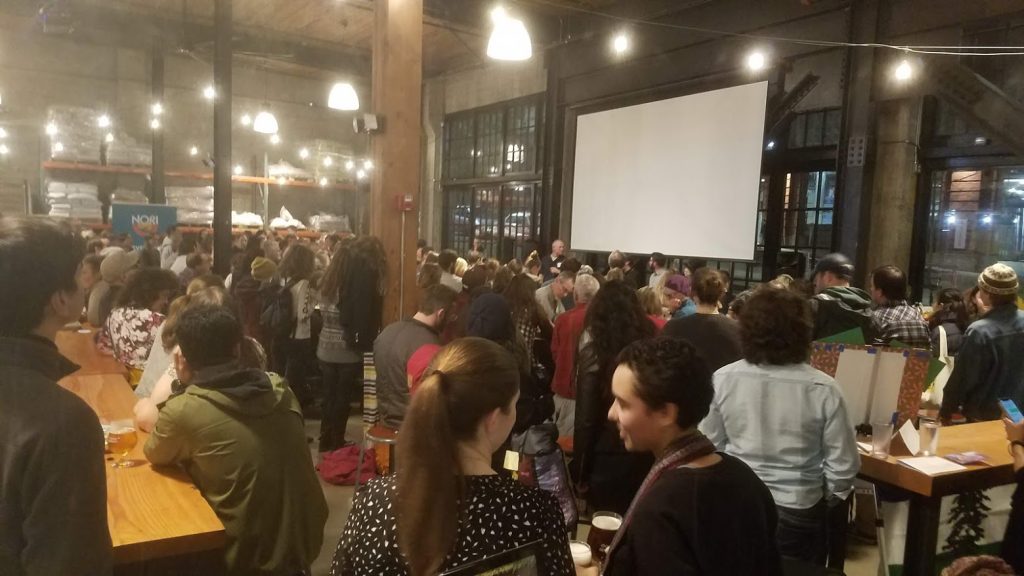
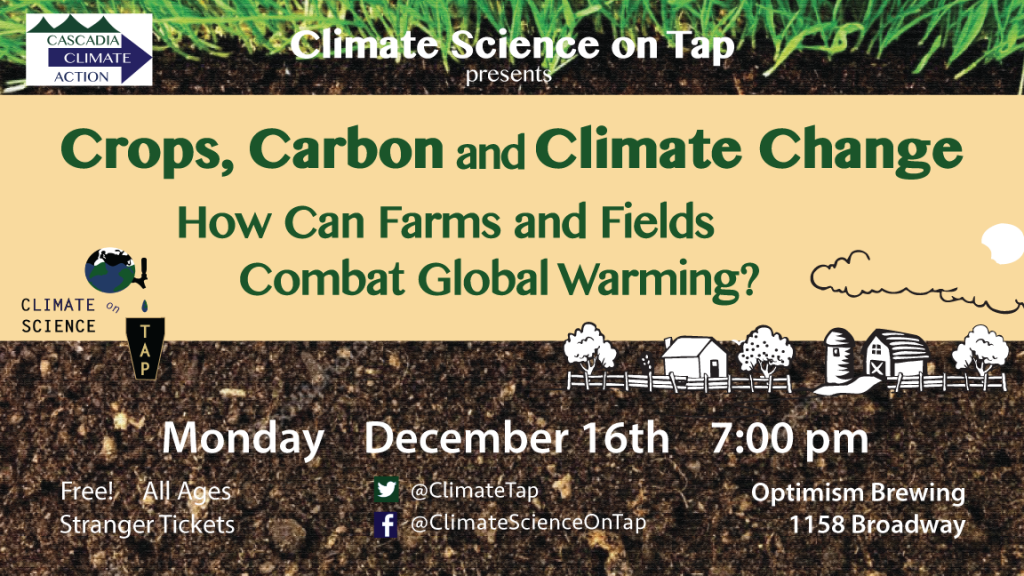
Below is a transcript and reportback of Cascadia Climate Actions Climate Science on Tap: Crops, Carbon and Climate Change – How Farms and Fields Can Solve Climate Change. It was held on 12/16/2019 at Optimism Brewing in cooperation with Carbon Washington and Seattle Tilth and had approximately 150 people in attendance.
This third segment features a written transcript of speaker Greg Rock. The first segment with David Montgomery can be found here. The second segment with Aaron Vardi can be found here.
Greg Rock
Moderator:
Yeah, thanks for coming. Really thanks for coming and thanks for staying with us even though we don’t have video. Hopefully you’re getting the points that are presented now for you, and you are filling out your comment cards because this is really the best way for you to contribute to the q&a that we’re going to have in just a couple of minutes. Now we have our last speaker last panelist.
Our last panelist is Greg rock. He’s an entrepreneur and climate activist. He’s also a board policy chair for carbon Washington. He has a master’s degree in sustainable energy engineering. He’s an audubon board member, and he’s served as part of the Washington’s volunteer lobbyist in Olympia for the last four legislative sessions. Greg’s climate action is around getting Republican legislators and rural Washingtonians more engaged and supportive of climate action, so we’re really excited to have Greg come up here and talk to you all. He’s used to talking without slides, he’s gonna be perfect for him. All right. Let’s give it up for Greg.
Greg Rock:
I actually didn’t want slides, originally, so I guess I got my wish. I feel bad though, but that’s the result.
I’m Greg with Carbon Washington. We are a grassroot organization we advocated for climate action in Washington State specifically around the achieving a net zero greenhouse gas emission for the state. That is a goal that we can achieve, we’re going to get there. The state was prepared to do it, we need to make sure we’re, we’re doing it. There are the important part about net zero is that’s not zero carbon emissions. Does everyone understand the difference between net zero and zero carbon emissions that the balance is what we call sequestration.
How many people know what sequestration is?
That is impressive. A couple years ago but much much smaller day reminds me of days like 15 years ago when you’d asked about climate change and about seven people in the back of the room. We know this is growing. The whole thing is growing rapidly. Everyone here knows what climate change is. Everyone is soon going to know what sequestration is because it’s a big solution set for the problem we’re facing.
So, sequestration is getting carbon dioxide out of the atmosphere, storing it in some form, hopefully, on the planet for a long period of time. You can sequester carbon for a year. And like the apple, that you might eat, we had a tree, and it absorbs carbon dioxide. It got stored in the apple you eat, and after you eat that Apple, you metabolize it, respirate it, and send the co2 back out into the atmosphere. We are all emitters of co2. It’s okay. Because there’s absorption that’s what’s called biogenic carbon. It’s all part of a loop that’s a very short cycle.
The problem for global warming is that fossil fuel carbon dioxide emissions are overtaking hundreds of millions of years in a way it’s already dioxide, and then release into the atmosphere in a very short period of time. But that does not mean the biogenic carbon flows can’t be a solution set and the near term problems we have today. We need to get to net zero carbon emissions by 2050. And every bed garden sequestration that we can deliver in farm ranch awful call to settings, even if it’s just an enhancement of a short term biogenic cycle can be a big contributor to our goal. Everybody on pages that. Can we vote, we can reduce emissions number one and we can also sequester carbon emissions. So the way we’re doing that are trying to do that in Washington State is with a bill called Senate Bill 5947, and we have these handouts, I’m not going to fold it but it’ll walk you through the mail over there people probably watching and say I didn’t know and Megan afterwards is also an engagement opportunity if you want to get involved in actually making this happen in Washington State, you can get involved, and that’s what we’re asking organizations and grassroots participants in the democratic process, do they make the things they want to change the world, occur locally, so they can happen nationally, so they can happen worldwide. So, Senate Bill 5947, one of the really unique majors in this bill is that it’s bipartisan. It is environmental it has some of the biggest republican names signed on supporting them assessors the head of the Republican Party in the Senate. He’s a farmer. In ritsuko, we farmer. He’s, he’s one of the prime spots of this bill. Senator McCoy on the Democratic side from the native tribe
is the prime sponsor of this bill. So we
have a unique mixture of Democrats and Republicans coming together around a solution set that truly is a win win. So, if we get if we reduce our carbon emissions. That’s great. We know it comes with a lot of benefits right there’s less local air pollution. So that’s good no benefit from reducing pollution. What’s interesting with carbon sequestration, is it also comes with a co benefit. The more carbon we get out of the atmosphere and store in our soil, rather than the ocean where causes implication, the healthier our soil gets, we just got explained very eloquently vice nobody’s been doing work on this for a very very long time so thank you David. The more we get out of the atmosphere, the more we do to address climate change to regarding sequesteration, the more resilient, our land comes to privacy consideration, the more productive our land, the more economically fruitful our farms and ranches. And I don’t know if you’re watching, but the economic situation in rural America right now is disastrous between trade wars between more yields. More crop prices. There’s an epidemic of farmer suicides in this country. This is a real real issue. We are undervaluing the environmental services that these parts of our world community, create. And so we want to get a bill out there that starts recognizing it. And so cynical vision and 47 is a voluntary grant program. It allows farmers, ranchers or octupole tourists to apply for grants on competitive basis, and they can apply for grants and three categories either reducing their greenhouse gas emissions, more efficient tractors, switching to biofuels rather than fossil fuels posted different technology switches that can make your operation more efficiency, or switch to a cleaner source. There’s also a second bucket around carbon sequesteration in the soil. So this is soil carbon. Carbon Farming and regenerative agriculture you’ve heard a lot of buzz words, direct incentives for farmers that can get more carbon into their soil. And finally this bucket around agroforestry so this is planting trees and farm and ranch settings, especially important here in Washington water and riparian buffers, because it protects a lot of salmon habitat and your
image. Of course there. So
that’s the that’s the
program. It’s a long term program it didn’t make good progress, out of the Senate last year we got held up in the house margin because it. The major commodity players felt the process was moving too quickly, and they were simple right we dropped this bill very late in session that it happened very fast we we are a small national organization in the hundreds of thousands of dollars category as you guys start doing anything a lot of money. Try one c three and c four so you know whatever works for you. But then the process was masking so now there was a $30,000 proviso that it’s plugged in. It’s basically a here on stakeholder process and we are working with a lot of major ag groups, trying to get them up to speed. Some of them are starting to move it in positive directions and others are jogging on peer
peer resistance II II so that,
and that’s real
that were there are some people that just heard you there yet, but this is a policy that can reach across the aisle. You can find the people who are there not just the legislators, but also the actual farmers, ranchers and say we want you to be part of this solution. And until we do that as Seattle. Reach approximated to the relevance and say we want to work with you on this, we don’t want to regulate what you’re doing. We don’t want to blame you. That’s what urban Seattle, we’re the number one polluter in the state.
It’s not rural America.
It’s us driving around in our cars, the food that they produce. So we didn’t have some real conversations about that and get involved. So I’m probably running a little over time. I’m not going to talk about some of the unique features of this bill. We do some commentary of how you prepare a vision offsets to sequesteration credit, even doing a lot of really being that research around that, that question with some of the university Washington professors, but I am going to say that this is really important that you act. It’s not because you’re one of 7.5 billion people in the world, and you have a voice that’s true. It’s not because you live in the United States, the economic powerhouse of the world with 350 million people, and your consumer choice clearly can change, who the rest of the world. Anyway,
everyone wants to be
us and how our lifestyle right now so we need to set the right example. But as you start thinking smaller you live in Seattle, Washington State
almost 757.5
million people here in Washington. Maybe you live in a legislative district like 36 right here in Seattle 150,000 people, and you have two of the most important legislators on this issue in a state that is poised
to make a big big difference.
So as I read that people in his legislative districts in Washington state the whole going and Microsoft, all these companies that have changed the world. We have the economic resources here to change the world, we have political leaders that are trying to change the world. What they need is more support.
And I see it.
You guys have more opportunity to 98% of the rest of the world. To address this issue. You know struggling family in Somalia can’t do much, you can. And one of things we do is get involved in this legislative session, January February is only two months out of your life. You can take a trip down there. Talk to your legislator testify every public hearing, when this and many other climate models like the low carbon fuel standard and it’s very
important this region is coming up.
And that’s
how we get this done. we actually working together, so long Bush, a lot of us have been doing this a long, long time. But we are making progress, just the number of hands in here that know what sequesteration is. I mean I’ve spent energy engineer I didn’t know what sequesteration was five years. So this is new stuff and we’re learning a lot and make a lot of progress, but we need to do it together. So I look forward to today.
So this morning, I would love to get all of our panelists, up front
here. They all have a microphone.
We’ve got Greg, David.
Before we get started with the q&a just want to remind you all to to how you might want to shape your day I forgot to mention when you first came in to visit it was sponsored by Cascadia climate action is the organization that you may realize it’s all about action, right, first action for tonight, is that you fill out your question. Okay, you’ve done that already, please pass it to our volunteer so we’re circulating around all of your questions, I know come by, pick that up. You should also make sure to check out cascadian. Now, or your one stop shop for all things related to crime related activities events ways to get engaged and alive. Last thing you should do before you leave tonight, we see on many tables around this venue they have lots of great ways to get involved with writing is already an engine garden Washington has some really great ways for you engage around the bill for coming up before the Washington Redskins yourself will be more about that in just a little bit. Please land and turning your questions going to be getting started with our q&a. I’ve already got some of those going now. So let’s go ahead and get started. So, the first question I think is for granted because you mentioned that this was up. You know y’all know that you focus a lot on bipartisanship and the work that you do. And this was a bipartisan bill. Do you think I mean, obviously there’s some advantages to that you see other avenues Besides this,
be able to get bipartisan support besides this one.
Yeah, I think there’s a number of categories that Republicans have expressed interest in more so that express things they don’t want it because they don’t want more regulation, and we’re not big fan of pricing mechanisms, unless external right but I see our water interesting waste the energy conservatives understand very well that you shouldn’t be wasting. And why would we waste energy and anything that returns a good bottom line. You know, it’s all about the framing about what you’re trying to do and I find them more open to considering ideas than
any thing other than a couple of the
big ones that we’ve put in front of them like capitals rain that’s been there for 10 years now. And they are entrenched position on making it so y’all reality mentioned also that we are recording this event. So if you’re having any trouble hearing or you would actually like to see I don’t know some slides, we will probably be able to do that in post production will probably add some cool special effects to it as an explosion to some laser lights. We’ll see. So, next question is for Aaron it’s a practitioner. You’ve heard about some of these interesting ways that we can sequester carbon. You talked
about. No, tell us Joe
and you talked about cover crops or fallow periods, not other folks you mentioned the
idea of file jar or bio saundra
wondering, first of all, if you can talk at all about the issue of bio charm. Do you have any experience with that because I know folks in the audience have asked questions about it. But then also, do you see situations in which some of these techniques are a little more or less suitable for large scale commercial type operation. My charge first, I’m not using it yet but I am thinking about trying to this next year, our fertilizer dealer has a lead on some pelletize biogeography. Because we don’t really have the resources to produce it ourselves to the scale that we would need for even our next small four acres
and limitations of scale. Yeah, well,
so the work we do with Wi Fi on the strip tillage that could be a definitely a pretty large scale operation I’m thinking like anything over five to 10 acres. But again, that research and development, and I mean it’s mostly combination technology leads in my view are like the biggest hindrance to reducing hotel. There’s a lot of weeds out there. And they’re more vigorous than our crops.
Yeah, so it’s the
equipment at this point for larger scale some of the smaller scale techniques are going to be using this next year, with the Charlotte tillers. That’s
quite labor intensive at this point.
There is quite a bit of research and development into the machinery and techniques to scale it up a little bit but anything beyond 10 acres of production, we are here this week, labor intensive, unless customers want to start paying a lot more theoretically so I think we should anyway. But the cost of that would have to be reflected in the price. Yeah, but it really depends on the crop you’re growing and scaling growing, and just quickly about the tools. It’s not only to do with like a coordinate technology, it has to do also with the genetic technology. And I’m not talking to you. I was I was talking in the past, we’re working with like I said
have been bred
to not really have to come up with ways, I think if we devoted some more energy to breeding crops that couldn’t be with all these reasons, we have. And that’s an integral part of the system we can only build machinery and techniques. We also need to develop the genetic side of it. So, pressure on the plants out there so because I think that that’s part of the equation that hasn’t really talked about.
Cascadia Climate Action organizes Climate Science on Tap panel discussions to build community understanding of, and engagement with climate change, its related causes, impacts, and solutions. Generally, they are held at breweries and tap houses, open to all ages, and bring out energy and climate scientists to share their expertise. Volunteer supported, the format fosters networking, learning, and action while being a great deal of fun!
More information, or submit an action event at http://cascadiaclimateaction.org/