
Featuring David Montgomery, PhD UW geomorphologist and author; Greg Rock, Masters – Sustainable Energy Engineering, and CarbonWA Policy Chair, and Aaron Varadi, Farmer, Program Mnager and Lead Instructor, The Organic Farm School.
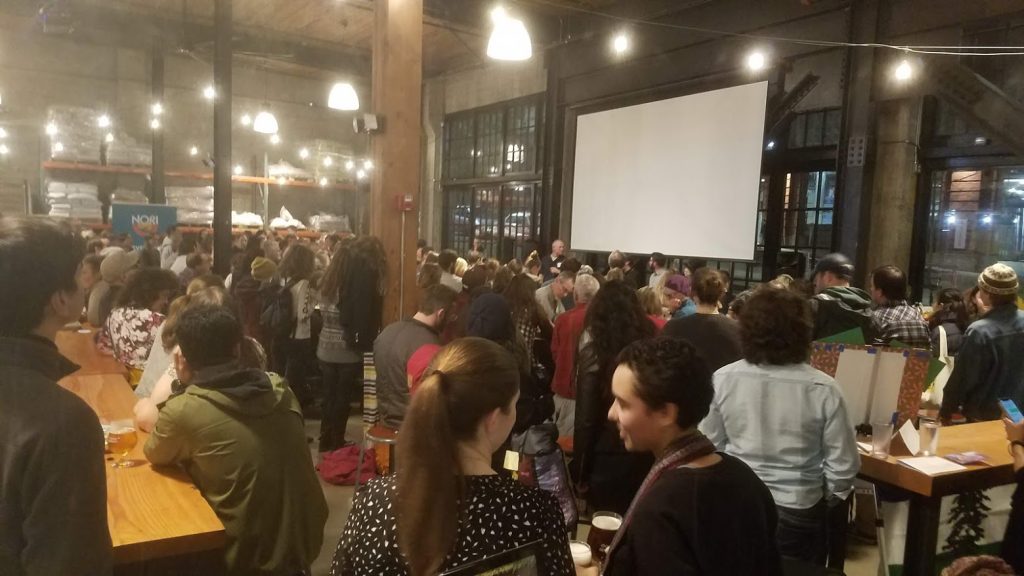
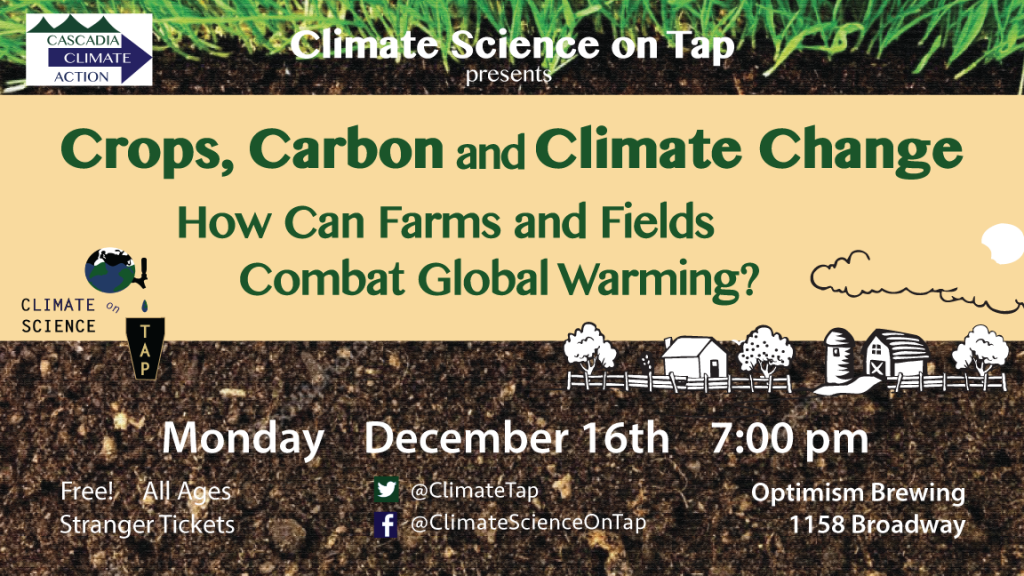
Below is a transcript and reportback of Cascadia Climate Actions Climate Science on Tap: Crops, Carbon and Climate Change – How Farms and Fields Can Solve Climate Change. It was held on 12/16/2019 at Optimism Brewing in cooperation with Carbon Washington and Seattle Tilth and had approximately 150 people in attendance.
This second segment features a written transcript of speaker Aaron Varadi. The first segment with David Montgomery can be found here. Other speakers to come soon.
Aaron Varadi
Moderator:
It’s my pleasure now to introduce our next panelist: Aaron Viradi is the program farm manager, and lead instructor for the Organic Farm School on Whidbey Island, where he had a yearly class with farm managers in training produce vegetables, pastured meats and grains and vegetables seed crops for farmers markets farms stands and grocery store accounts and seed companies.
The Organic Farm School has been trialing and incorporating a range of reduced tillage techniques for the past several years in partnership with various research institutions in an effort to sequester soil carbon and increase soil health. So Aaron is going to tell us a little bit about their efforts up on Whidbey Island from a real practitioner’s standpoint. So let’s welcome Aaron up front to tell us all about it.
Aaron Varadi:
Hi everyone, thanks for coming.
So I grow vegetables mostly, so I’m going to speak to that. Nice, nice variance. It seems like no till and reduced tillage has come a lot further and a lot faster for grains & legumes in large scale fields. And I can speak more about them later, but for vegetables, these crops we grow as they have evolved in systems that really discourage any competition so like weeds, mulch, a lot of these properties grow when they leave, or they very much prefer a clean seed bed with no competition.
So thanks to tillage, you know, it’s always bad, which is because we’re trying to prepare seed beds so our crops can grow, so this year about 75% of our farm we’re doing fairly standard tillage. Pretty in line with a lot of the organic vegetable farms in the region. I had some explicit photos of all of our equipment, but I’m trying to paint you a word picture.
Basically you’re just trying to turn the whole field around, you know, like you’re trying to incorporate the copious amounts of cover crops that we do grow — cover crop is my favorite crop. You know, you can generate tons of biomass per acre — grow it yourself, and then incorporate it, terminate it — you gotta kill that stuff.
How do you kill that stuff? You usually, sometimes when it flowers, usually done with harrow or some piece of equipment. And I will say, even though we’re not where we should be at yet, we have been taking soil samples every year and even with that regimen, we are increasing our soil organic matter by about point 4% every year in the last three years, since we got on the site. So that is one way you can increase organic matter but it’d be great if we can do it faster. So we have been tinkering with a couple of different reduced tillage methods, both in house and in partnership with Washington State University.
So I’ll talk about the WSU trial first, and that was the trial on strip tillage, which I believe there’s a very fine publication online. You can find about that. But the general idea is instead of turning the whole field around back to dirt, you grow a very tall cover crop size you can get it, and then flail mow that or sometimes you can use another piece of equipment called a roller crimper, anyway you till that cover crop, lay it down as mulch.
So you got all the benefits of a mulch on the soil, but sometimes it’s also a detriment depending on the crop. But then, so you got that mulch instead of tilling it all, you just do strips like you till strips where your rows of squash or broccoli are going to go.
And so we tried that out with WSU, Doug Collins, a researcher there for a couple of years with winter squash and broccoli. Pretty promising results but you got to pick the crops right. And not all crops that respond well to that system but we kind of got to pick and choose what works best for each job.
And another system we’re trialing now just started is rather than to reduce tillage by square footage is reduced tillage by cubic foot. So let’s say instead of tilling really deep, all the way across the field like regular Joe’s with me and instead of telling Justin strips pretty deep this new system would be a shallower former killer so ideally only disturbing soil, down to two to four inches forages. This system has been popularized by Gene Martin Fourtier, the Market Gardener, maybe you’ve all read it. He’s an Instagram celebrity right now.
But the idea with that is permanent raised beds. apply a lot of organic matter, so compost, manure, cover crops if you can get your systems down right, and then instead of tilling very deeply you’re using a tool called the power harrows, basically you can go very shallow, because, again, plants like a pretty clean seed bed and you need to incorporate your … as well.
So basically the take home message I think, for vegetables in our system right now is that there’s still a lot of work to be done. And there’s a lot of equipment that needs to be developed, which I think ties really well into our next project. There are ways to do this out there. We’re all pretty smart, we can figure it out. We just need the tools to do it. And I think we’re getting there. So I will end it there and can answer … questions later.
Thanks for coming.
Cascadia Climate Action organizes Climate Science on Tap panel discussions to build community understanding of, and engagement with climate change, its related causes, impacts, and solutions. Generally, they are held at breweries and tap houses, open to all ages, and bring out energy and climate scientists to share their expertise. Volunteer supported, the format fosters networking, learning, and action while being a great deal of fun!
More information, or submit an action event at http://cascadiaclimateaction.org/