
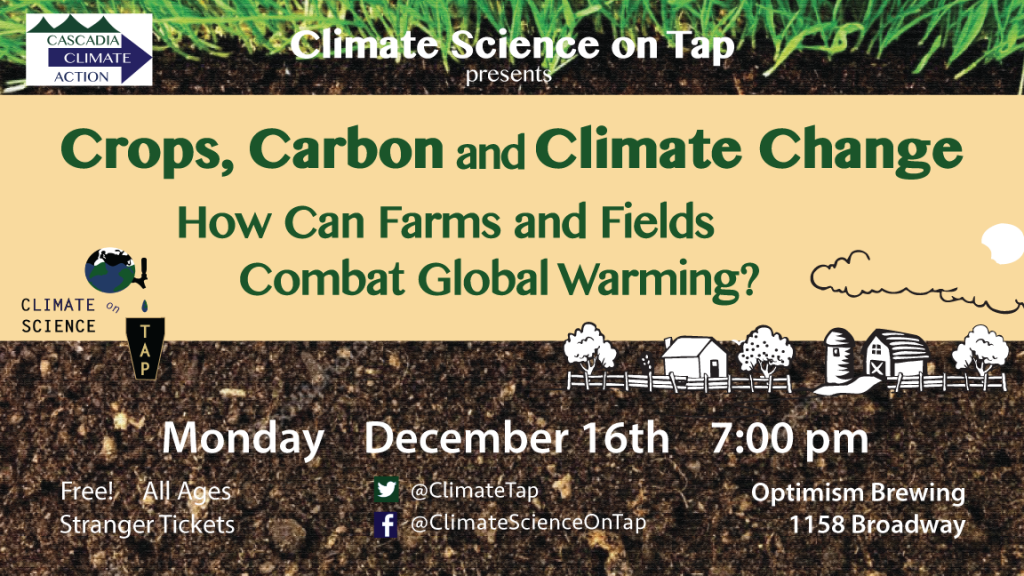
Featuring David Montgomery, PhD UW geomorphologist and author; Greg Rock, Masters – Sustainable Energy Engineering, and CarbonWA Policy Chair, and Aaron Varadi, Farmer, Program Mnager and Lead Instructor, The Organic Farm School.
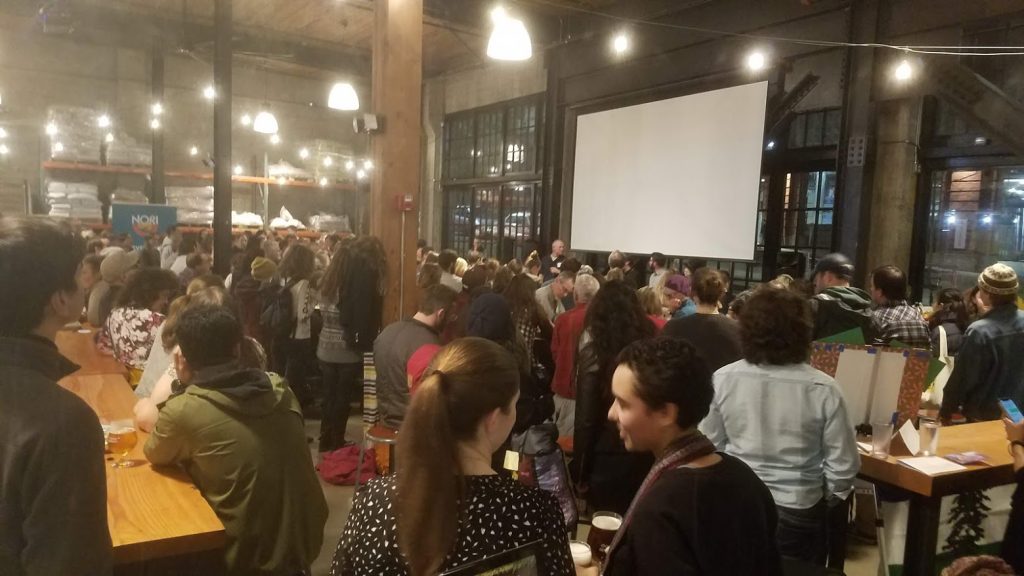
Below is a transcript and reportback of Cascadia Climate Actions Climate Science on Tap: Crops, Carbon and Climate Change – How Farms and Fields Can Solve Climate Change. It was held on 12/16/2019 at Optimism Brewing in cooperation with Carbon Washington and Seattle Tilth and had approximately 150 people in attendance.
This first segment features a written transcript of David Montgomery. Other speakers to come soon.
David Montgomery
Moderator:
So without further ado, David Montgomery. Let’s give it up again, and if you want to see a really weird interview, go watch the YouTube clip of the fox and friends one.
David Montgomery:
What’s funny is, listen to what I say, listen to the little crawler, the little streaming at the bottom and watch the disconnect between what it says and what I said. It was really fun. But anyway, it’s my job tonight to try and set the stage a little bit for looking at regenerative farming as a way to pull carbon from the atmosphere and put it back in the ground.
There’s lots of other reasons to engage regenerative farming but that’s the appropriate one for that.
I got into this as a geologist by basically looking at the other side the degradation of land, and how societies that are history had essentially pulled carbon from their soil and put it in the atmosphere is in the process that started thousands of years ago with the dawn of agriculture which was the way that we had conventionally farmed.
It turns out the villain of the first book that I wrote with for a class on soils, which was called Dirt: The Erosion of Civilizations and the villain in that book was the Plow because what was that cloud to do by turning the surface of the earth over and oxidizing it and it accelerates microbial breakdown of organic matter that’s a dead stop. What makes healthy fertile soil is the combination of mineral matter, and once living things; bacteria and fungi and worms and all those other things that all you gardeners know about.
If you plow the land too often for too long you burn through that organic matter and the fertility goes down, this is one of the reasons why the modern era of chemical intensive fertilizer use was so attractive. It was early 20th century because the Western world that already degraded their land that’s what I wrote about in the dirt book and the basic bottom line of that book is that we burn through roughly about 50%, that’s a half, of the soil organic matter that we had in America’s Heartland at the time that Europeans arrived in North America. Globally, it’s about the same we heard about half of the organic matter of our agricultural soils, we just done it in different phases and different parts of the world.
But if you add all that carbon up, about a third of the amount of carbon that’s been added to the atmosphere since the Industrial Revolution, made from plowing up the Great Plains, plowing up the steps of Russia, plowing up parts of central Asia, we can actually put at least that much carbon and actually a lot more it turns out back in the ground if we change the way that we farm.
And if you want to go look at places where you can see this, you can go to farms all around the country and see the organic matter content has dropped to one or to two percent, while the native amount was more like four or 5%.
So, how can we actually turn that around?
I actually started to learn that lesson in a very different place, and that is in my yard in North Seattle. I live up in Green Lake / Wallingford area depending on who is asked about what neighborhood it is, but we bought a place that had very dense soil. It was basically dirt that existed when we took our old growth lawn off, and tried to actually plant a garden, we didn’t find any worms. No life in the soil, which was about the color of these tabletops… now it is about the color of my jacket [black].
That difference is carbon back in the ground. We took it from about 1% organic matter up to almost 10% a little over a decade.
And it was all about the way that we learned. And if you actually run the numbers that’s putting tons of carbon into the soil, into our yard. Now it’s not going to stay there forever. Right. That’s one of the things about soil carbon is that it moves. You have to keep gardening the way that builds soil organic matter to keep it there. But we’ve gone from being a net importer of organic matter where we’re getting compost and mulch from our neighbors, Seattle Zoo, coffee shops, breweries – wherever we get it.
We now grow so much organic matter that we don’t need it to mulch everything that we’re exporting. So we become a carbon sink in our yard.
And I got really interested in whether or not you could do the same kind of thing on farms, and that basically formed the basis of the book I most wrote most recently Growing a Revolution: Bringing our Soil Back to life. And what I did is I basically went around the world to interview farmers who had already restored their soil taken it from lower organic matter to higher organic matter. In doing so they’ve been able to reduce their fertilizer use by 50 to 90%, they reduce the pesticide use by 50 to 90% because their diesel bill in half by at least.
What are the three biggest expenditures on a modern agricultural farm? Fertilizer, pesticide and diesel. What are three of the biggest environmental footprints of the modern chemical agricultural farm? Fertilizer, pesticides diesel.
If we could actually decrease that use that’s a victory in of itself. But those farmers who are in line with the three principles of conservation agriculture: minimal tillage, keep your cover crops in the ground at all times, and plenty of diversity. Not planting one or two crops, but growing a diverse community of life.
That’s a recipe for building soil organic matter by supporting the life in the soil and the farmers I visited who had done all three also raising soil organic matter dramatically in a really short period of time. Now I’m a geologist, so a short period of time is a decade or two, but it took societies around the world centuries to destroy their land in the past, and we can actually fix it in decades. That’s where there is a cause for optimism and for talking about Carbon Farming as a legitimate way to put carbon in the soil.
And if you if you run the numbers in terms of how much carbon you can pull out of the atmosphere by changing agriculture globally through these conservation agricultural practices they’re all over the map, depending on the assumptions you make, who you talk to, how much land you’re actually can convert. But at the reasonable high end of those estimates you can basically argue that your combination of forestry practices and agricultural practices we could probably pull out about as much carbon out of the atmosphere is we’ve added since Industrial Revolution because we did it on all of our land everywhere, all of our forest land everywhere.
That’s a high life, I don’t think we can pull the whole thing off but the point is, those are big numbers. We can we can reduce our environmental footprint of farming and probably grow more nutritious food while we’re at it.
That’s the book Dan and I are working on now, that we’re here with regenerative agriculture that grows food that’s actually more nutritious for people, why you should care about where your food is grown in the words of the farmers market who’s over there why you shouldn’t take food from strangers, you should know how your food is grown.
It turns out that if you’re really looking at the full carbon budget of whether eating a plant based diet or eating meat, the most important question to ask is how were the cattle was raised, not whether you’re eating corn and soy, but how it was raised. To answer the questions about the heart and thinking about reframing the conversation about agriculture, but it’s basically my job to basically illustrate that.
The idea of putting carbon back into the ground. There’s one word solidly backed up by the experienced departments around the world there’s good science involved in them as well. There’s a lot of work that needs to be done in it. But the biggest lift on that is trying to incentivize and encourage farmers to participate in it.
The good news is it’s more profitable for farmers to do regenerative farming than conventional farming. And that’s why it’s starting to take off in the Midwest. I never imagined as a professor from Seattle, that I would be invited to talk about farming communities around the Midwest, but that’s what I’ve been doing for the last four years almost non stop. Talking about the promise and potential regenerative agriculture, and I see the biggest support for it from two communities the climate community, like you all, and the farming community.
We have a real opportunity for an alliance there between two groups of society that don’t tend to see things fairly similarly, because, whether you’re trying to reduce our costs, increase profitability, or you’re trying to pull carbon from the atmosphere, the recipe is to put carbon in the ground to do it, because that’s how you build fertile soils.
So I’ve probably about consumed about what my allotted amount of time will be. We’re going to do a q&a after we get through the three of us speaking and I brought copies of the books that I was just talking about. If you want to pick up copies, obviously, I encourage you to do so.
I will hand it back to you. Thank you!
Cascadia Climate Action organizes Climate Science on Tap panel discussions to build community understanding of, and engagement with climate change, its related causes, impacts, and solutions. Generally, they are held at breweries and tap houses, open to all ages, and bring out energy and climate scientists to share their expertise. Volunteer supported, the format fosters networking, learning, and action while being a great deal of fun!
More information, or submit an action event at http://cascadiaclimateaction.org/